

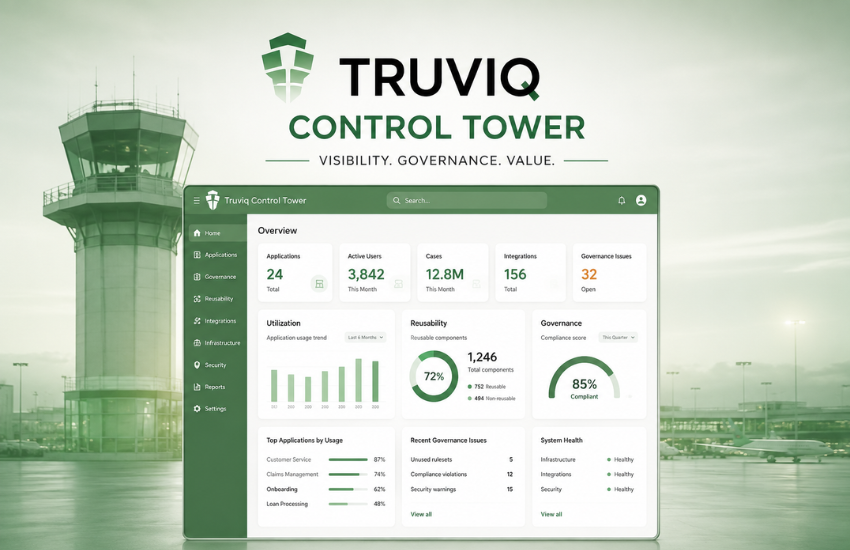
Branded content with Truviq Systems
An enterprise-ready operating system for the Pega estate giving leadership control and transparency over utilization, reusability, and compliance, and finally answering what a Pega investment is actually returning.
Key Takeaways
- Pega estates keep growing, but visibility into what’s built and used does not.
- CoE teams still answer platform ROI questions with spreadsheets and gut feeling.
- Truviq Control Tower brings a single operating picture across the entire Pega estate.
- Three pillars drive it: utilization analytics, a reusable asset repository, and continuous guardrail governance.
- AI powered recommendations flag reuse opportunities before teams rebuild what exists.
- OAuth 2.0 scoped access and enterprise security are built in from day one
Over the past few years, I had the opportunity to work as part of a Center of Excellence (CoE) team managing multiple Pega applications within a large enterprise. Our responsibilities went far beyond delivering new features or resolving production issues.
We constantly asked ourselves questions like:
Which applications are actually being used? Are different teams building the same functionality multiple times? Which applications require modernization? Are all projects following governance standards? How healthy is our overall Pega platform?
Those questions become increasingly important as organizations mature their Pega landscape.
Building an enterprise application is only the first step.
Managing an entire Pega estate is a completely different challenge.
A Conversation That Immediately Resonated
During one of my discussions with Suneel Sundaraneedi, CEO of Truviq Systems, he walked me through their product, Truviq Control Tower, and the idea immediately resonated with me.
He called it a Control Tower for the Pega Estate.
Having spent over two years working within the aviation industry, that analogy instantly made sense.
An airport doesn’t operate simply because aircraft know how to fly. Every aircraft is monitored through a central control tower that continuously observes movements, coordinates operations, and identifies risks.

Without that visibility, individual flights may still operate. But managing the entire airport becomes increasingly difficult.
The same principle applies to Pega.
Applications can individually perform exceptionally well. But when an organization operates dozens, sometimes hundreds, of them across departments and geographies, leadership needs more than individual application dashboards.
They need visibility across the entire platform.
The Question Leadership Actually Asks
Let’s make one thing clear. This isn’t about a limitation within Pega. The platform handles enterprise complexity extremely well, and most implementation teams have become incredibly good at building applications.
The real challenge begins after those applications go live.
Each team measures success independently. Application A. Application B. Application C.
But executive leadership doesn’t invest in applications. They invest in platforms.
When budgets are reviewed or licensing is renewed, they’re asking one question: “Are we getting value from our Pega platform?“
How many applications do we have? Which departments use them? Are teams rebuilding the same components? What is our return on investment?
Surprisingly, many organizations struggle to answer these seemingly simple questions.
Not because the information doesn’t exist. But because it exists everywhere. Across environments, teams, spreadsheets, and reporting tools.
There is rarely a single place where leadership can see the complete picture.
Suneel summarized it perfectly:
After almost 20 years in this ecosystem, the pattern we kept running into wasn’t a Pega problem. It was a visibility problem. Large enterprises weren’t struggling to build on Pega. They were struggling to see what they’d already built and prove what it was worth.
– Suneel Sundaraneedi, CEO, Truviq Systems
Each team understands its own application. Very few understand the platform.
Measuring What Actually Matters
When organizations evaluate the health of their Pega platform, three themes consistently emerge.
Not technology. Not features. Not architecture diagrams.
Measurable indicators of platform success. These three pillars form the foundation of Truviq Control Tower:

Utilization. Reusability. Governance.
Rather than relying on assumptions or periodic audits, organizations gain continuous visibility into the health, maturity, and value of the entire platform.
Let’s look at each pillar.
Pillar 1: Utilization
Applications get built, go live, and quietly fade from attention. Until someone asks why the infrastructure bill keeps growing for servers that barely see traffic.
Control Tower gives administrators case volume analytics across every registered environment, alongside server node health.
You see exactly which applications carry heavy case traffic and which have gone quiet. One application generating close to a thousand cases, sitting next to another with barely a few dozen.
That’s a direct input into where to invest, where to decommission, and where infrastructure is being paid for but not used.
Most Pega renewal conversations run on opinion.
Control Tower gives them a number.
Pillar 2: Reusability
In any estate with more than a handful of applications, the same component gets built more than once.
Not from carelessness. Nobody outside one team knows it already exists.
Control Tower’s enterprise asset repository changes this. It’s a shared, searchable catalog where reusable components are published, described, and approved across teams, instead of buried inside one application nobody else will find.
AI powered recommendations actively flag reuse opportunities across the estate.
Every component rebuilt from scratch is a number you can put next to a dollar sign. Reusability isn’t a nice to have. It’s a line item.
Suneel Sundaraneedi, CEO, Truviq Systems
It’s the kind of leak that’s invisible until someone measures it. And obvious in hindsight once they do.
Pillar 3: Governance
Guardrail compliance drifts quietly.
Teams build fast, deadlines win, and best practice adherence slips without anyone deciding it should. Until an audit or a new architect asks an uncomfortable question.
Control Tower makes compliance continuous.
Real time guardrail scores. Version tracking across every registered environment. A mass communication tool to reach application owners directly, instead of chasing them over email once a year.
Governance done once a year isn’t governance. It’s an autopsy.
Suneel Sundaraneedi, CEO, Truviq Systems
Blunt, but accurate. By the time an annual audit finds a gap, it has usually been compounding for months.
What Administrators Actually See Inside
Think of Control Tower not as another dashboard, but as a live operating picture of the entire estate.
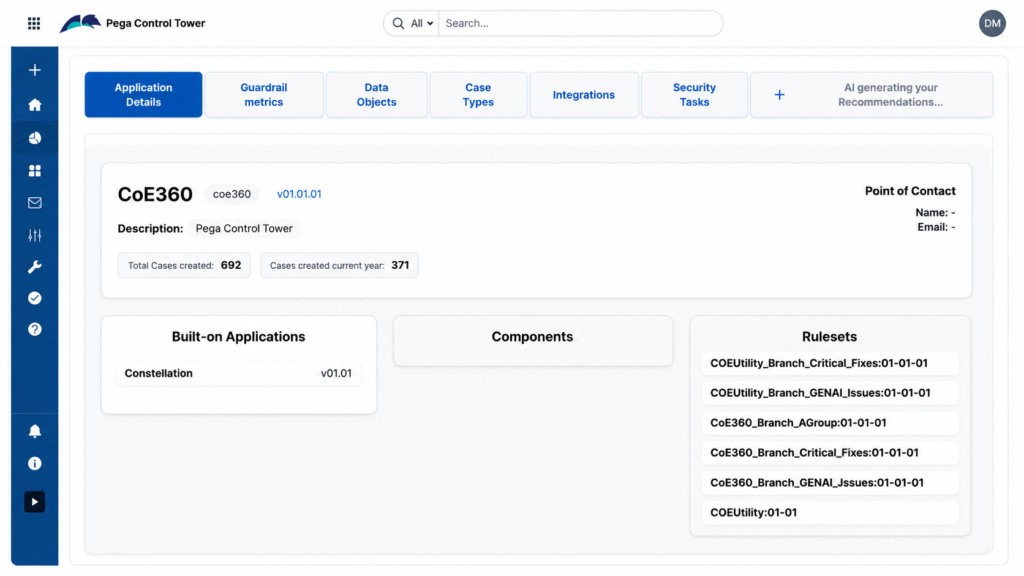
The App Dashboard consolidates every application’s latest version, ownership, and configuration. Guardrail monitoring shows live scores and warnings. Additional views cover data types, case types, integrations such as Connect REST and Service REST, security tasks, and reuse recommendations.
No switching between environments to piece the picture together manually.
Each environment is registered through OAuth 2.0, so access is scoped rather than open ended. That matters in regulated industries where the applications being measured handle sensitive customer and case data. Control Tower continuously pulls the data from there.
Teams can then act directly. The mass communication tool reaches application owners with pre-built templates. The asset repository lets teams publish reusable components through an approval workflow.
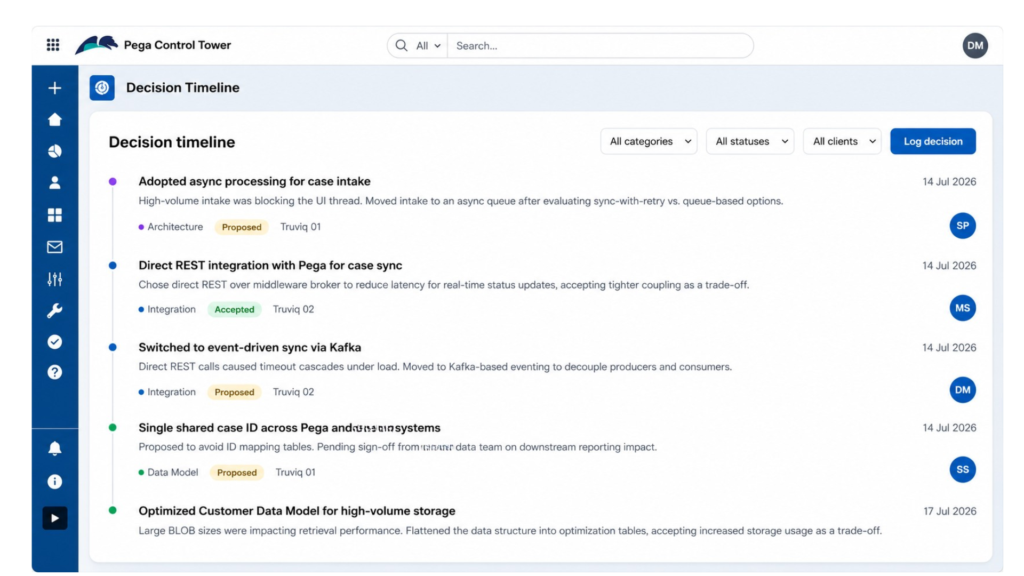
You can log all your architectual decisions and save it for future references and review.
No custom reporting scripts. No cross-environment spreadsheets.
The operating layer is already there, updating in real time.
Where the Three Come Together: The ROI Conversation
Utilization, reusability, and governance are useful alone.
Together, they answer what leadership actually wants to know: is this platform earning its keep?
A CIO opening Control Tower’s consolidated view sees, in one place, which applications are ripe for consolidation, how much rebuild effort is avoidable through reuse, and whether the estate is compliant enough to avoid a costly remediation project.
That turns Pega from a line item finance questions every renewal cycle into a platform with a defensible, quantifiable ROI story.
Pega remains the system that runs the business process. Control Tower becomes the operating system that proves the investment is working.
Suneel Sundaraneedi, CEO, Truviq Systems
This applies across industries.
Banking and financial services often run Pega across lending, KYC, and servicing simultaneously, with real pressure to prove platform ROI at every renewal cycle. Control Tower gives CoE leads a defensible number instead of a gut feeling.
Insurance carriers running claims and underwriting on Pega tend to accumulate duplicated components across business lines fast. The asset repository alone can meaningfully cut rebuild costs.
Healthcare organizations running Pega for care management or appeals and grievances carry the added weight of regulatory audit requirements, where continuous guardrail visibility matters as much as the ROI case.
Government and public sector platforms often run for years with underused capacity and no reusability discipline, simply because nobody was ever tasked with measuring it.
Wherever a Pega estate is large enough that “are we getting value from this” is hard to answer with confidence, there’s a gap Control Tower can close.
Behind the product, Truviq brings over a decade of BPM and AI led transformation across banking, insurance, healthcare, and government, including Pega Client Lifecycle Management, KYC automation, and cloud migrations. That delivery experience is what makes this bigger than a monitoring tool. It’s a platform leadership can trust when the number it shows affects budget decisions.
How to Reach Truviq
If your organization has ever struggled to answer what it’s actually getting from its Pega investment, Truviq Control Tower is worth exploring.
Start at truviq.com. Ask specifically for a walkthrough of the case volume analytics and the enterprise asset repository. That’s where the ROI story becomes concrete fastest, once you see real utilization and reuse data instead of estimates.
Truviq is also active on LinkedIn as Truviq Systems, a good way to follow product updates and customer stories.