


As a Pega professional, I have been fortunate to witness the evolution of Pega’s low-code application-development experience.
I saw Pega Express emerge during the Pega 7 era. I saw it mature into App Studio. I watched App Studio grow alongside Theme Cosmos, Constellation, DX APIs, Insights, Blueprint, and Pega GenAI.
Now, with Pega Infinity ’26 introducing Pega Infinity Studio as its unified, AI-assisted development environment, App Studio is preparing to leave the main stage.
And strangely, I feel a little emotional about it.
Because I have a confession to make:
For most of its life, I did not really like App Studio.
As a hardcore Pega developer, Dev Studio always felt like home. App Studio felt simplified, restrictive, and designed for someone else.
But slowly, release after release, App Studio became more capable. Constellation changed how we built user experiences. Blueprint made it the natural place to begin application development. Features that once required Dev Studio started appearing inside App Studio.
And just when I finally started enjoying it, Pega announced the next chapter!
Poor App Studio.!!
So before it gradually steps away from the spotlight, I think it deserves a short tribute.
The beginning: Pega Express
The story began during the Pega 7 era with Pega Express.
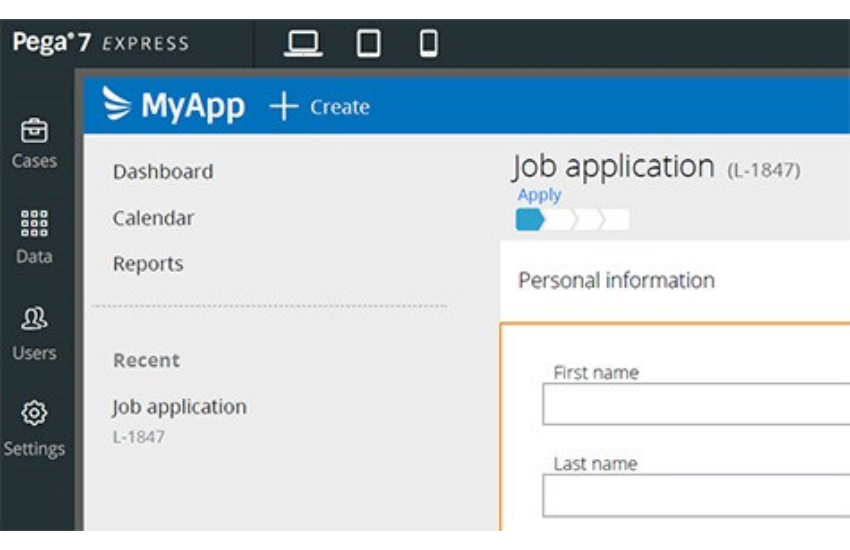
Pega positioned it as an accelerated, low-code application-development experience. Instead of starting with technical rules and class structures, users could begin with the business process.
This was important because low-code platforms were rapidly gaining attention around 2015 and 2016.
Pega had already been practising model-driven development for decades. We were creating flows, rulesets, decision tables, data models, and user interfaces visually long before “low code” became one of the most popular terms in the software industry.
Pega Express made that capability much more approachable.
It provided a cleaner environment where business users, citizen developers, and application developers could model a case lifecycle without immediately confronting the full technical depth of the platform.
The early experience was relatively limited compared with what came later.
But the direction was visible:
Application development should begin with the business journey not with the technical implementation.
Over the next few Pega 7 releases, Pega Express continued to grow. More capabilities appeared for configuring cases, data, application settings, themes, channels, and other parts of the application.
The small studio was growing up.
The upgrade to App Studio
Then came Pega Platform 8.
Pega reorganized its development and administration experience around role-based studios – App Studio, Dev Studio, Admin Studio, and Prediction Studio.
Pega Express evolved into App Studio, the low-code development environment intended primarily for application developers, business architects, front-end developers, data engineers, citizen developers, and system architects.
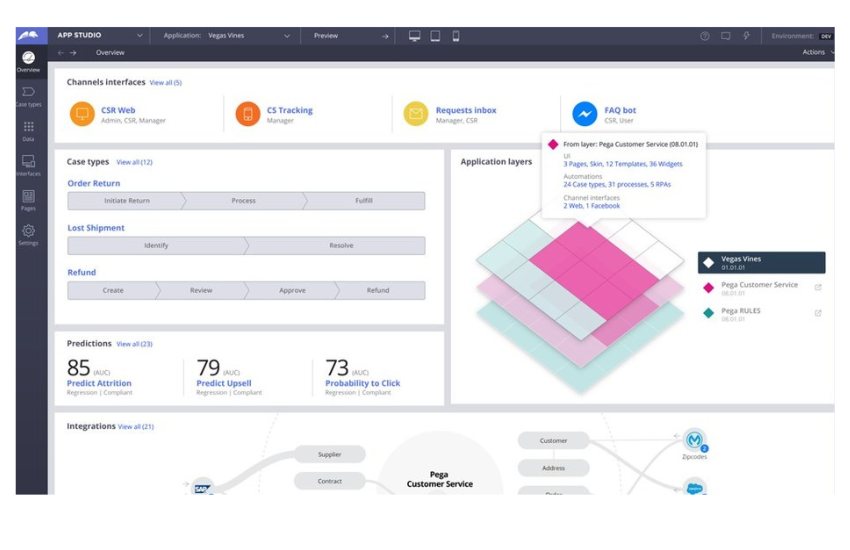
Dev Studio remained the place for deeper and more advanced technical configuration.
This separation made sense.
App Studio focused on the business application and its journeys. Dev Studio exposed the complete rule-based platform underneath it.
But many experienced Pega developers, including me already had a favourite!!
Whenever we created a new application, the default author access group usually opened App Studio.
And what did many of us do immediately?
We switched to Dev Studio.
Some of us even changed the default portal in the access group so that we did not have to see App Studio every time we logged in!
Poor App Studio had welcomed us through the front door, and our first action was to find the Dev Studio exit. 😉
It was not because App Studio was bad.
We were simply comfortable with the tools we already knew.
Looking back, perhaps App Studio was not taking technical power away from us.
It was trying to change the order in which we thought about the application.
The Cosmos chapter gave App Studio new importance
The next major chapter arrived with Theme Cosmos and the emerging React-based UI architecture.
Theme Cosmos became available during the Pega 8 era, and from Pega 8.4, Pega recommended it for new applications. App Studio provided the intended low-code experience for configuring the application UI while remaining within the design system.
This was also when we began hearing an important message:
Think in Views, not only in Sections.
For developers who had spent years building harnesses, sections, dynamic layouts, and controls, this required a different mindset.
App Studio was becoming central to that new authoring experience.
But old habits are difficult to change.
Whenever App Studio did not expose the option we wanted, there was usually a very attractive escape route- switch to advanced configuration.
Many of us clicked it without hesitation and continued configuring Sections in Dev Studio.
I was certainly one of them.
App Studio encouraged me to stay within the guardrails.
Dev Studio gave me the freedom to configure almost anything.
Meanwhile, the platform continued evolving.
Theme Cosmos matured. Cosmos React gained early adopters. DX APIs became a bigger part of the architecture. The idea of separating the experience layer from the application’s business logic started receiving much more attention.
App Studio was no longer just the simplified studio for citizen developers.
It was becoming the primary authoring experience for Pega’s next generation of user interfaces.
Constellation gave App Studio its Infinity Stones
Then came the Pega Infinity ’23 era.
Cosmos React evolved into what we now know as the Constellation architecture and design system.
For new applications, Pega’s strategic direction became much clearer. Constellation was the preferred UI architecture, while the traditional UI architecture continued mainly for existing applications and use cases that had not yet moved.
This gave App Studio a completely different level of importance.
Constellation applications were designed around Views, templates, prescribed components, DX APIs, and a stateless frontend architecture. App Studio became the natural place for configuring much of that experience.
The relationship worked both ways:
Constellation increased the importance of App Studio, and App Studio made Constellation development accessible through low-code authoring.

The developer experience also began changing.
Capabilities that many developers once associated only with Dev Studio gradually became accessible through App Studio. Application teams could configure increasingly sophisticated data, integration, security, channel, and user-experience requirements without leaving the business context of the application.
Pega Academy reflected this direction as well.
System Architect and Lead System Architect learning increasingly emphasized App Studio, application design, reusable Views, Constellation patterns, and building within the recommended guardrails.
The message was becoming difficult to ignore: do not begin in Dev Studio simply because you know Dev Studio. Begin with the business journey and use App Studio wherever it supports the requirement.
Slowly, the adoption increased.
And so did my appreciation for App Studio.
Blueprint and GenAI took App Studio to its peak
Then AI entered the room.
Pega introduced Pega Blueprint, giving teams a new way to begin with a business problem and transform it into a structured application design containing case types, stages, steps, personas, data objects, and other application elements.
A Blueprint could then be imported into Pega and used as the starting point for development.
This gave App Studio an even stronger role.
App Studio provided the bridge between the generated application structure and the developer who needed to make it real.
At the same time, App Studio continued receiving more intelligent capabilities.
Insights made application data easier to explore and visualize. Pega GenAI helped users generate content and configure Insights. AI-assisted design and testing capabilities began becoming part of the development experience.
By Pega Infinity ’25, App Studio was probably more capable and relevant than at any previous point in its history.
More organizations were adopting Constellation. More development activities were moving into the low-code experience. Blueprint was becoming the preferred starting point for new applications.
For the first time, it felt as though App Studio might eventually overtake Dev Studio as the primary home for many Pega developers.
And for the first time, I was no longer trying to escape from it immediately.
I had finally started liking App Studio.
That is when the plot twist arrived.
Infinity ’26 introduces a new studio
With Pega Infinity ’26, Pega introduced Pega Infinity Studio.
Infinity Studio is a unified, AI-native development environment that combines application design, configuration, and debugging within one workspace.
Infinity Studio consolidates the tools and capabilities previously distributed across App Studio and Dev Studio. Pega Infinity ’26 discontinues Dev Studio, while App Studio is no longer recommended as the development environment for Pega applications.
The decision makes sense.
The separation between App Studio and Dev Studio always created a certain amount of context switching.
Developers would begin in App Studio, move into Dev Studio for an advanced configuration, return to App Studio to update a View, and switch again when they needed to inspect the underlying rules.
The distinction between a “citizen developer studio” and a “professional developer studio” was also becoming less clear.
AI is changing how applications are built.
A business user, solution designer, system architect, and experienced developer may all work within the same environment, but interact with it at different levels of abstraction.
Infinity Studio brings those experiences together.
It carries the structure and intent from Pega Blueprint into implementation. It embeds Blueprint AI guidance, provides an AI Assistant, introduces an integrated implementation plan and integration-design experience, and supports development through external AI coding agents using Infinity Build MCP.
Pega describes it as a development environment that combines AI speed with Pega’s established guardrails, governance, and application-development best practices.
From a platform-evolution perspective, this is the logical next step.
Instead of asking whether to build in App Studio or Dev Studio, the developer can remain within one environment and use the appropriate level of capability for the task.
So, did App Studio lose?
I do not see it that way.
At first glance, it may feel as though Dev Studio evolved into Infinity Studio while App Studio was simply retired.
But when we look more carefully, much of the philosophy behind Infinity Studio came from App Studio.
Infinity Studio continues the ideas that App Studio spent years introducing. Begin with the business outcome. Model the case lifecycle visually. Keep application development close to the user journey. Make advanced platform capabilities easier to consume. Build within prescribed patterns and guardrails. Reduce the distance between business and IT. Use Blueprint as the bridge from design to implementation. Make low-code development suitable for both new and experienced developers.
The deeper technical capabilities of Dev Studio have not simply vanished either. They are being reorganized into a unified development experience.
So perhaps App Studio did not really get the axe.
Perhaps its ideas won.
The separate studio may be stepping away, but its low-code, outcome-first philosophy has become part of the foundation for what comes next.
Thank you App Studio
App Studio and I had a complicated relationship.
Eventually, Constellation and Blueprint helped me understand its real purpose.
It was trying to make us build closer to the business outcome, use the platform’s recommended patterns, and reach for advanced configuration only when the requirement genuinely needed it.
I may not have appreciated that enough during its early years.
Now, just when I have started feeling at home there, Infinity Studio has arrived to take the journey forward.
That is how technology evolves.
Developer Portal became Designer Studio. Designer Studio became Dev Studio. Pega Express became App Studio. And now, many of those experiences are coming together inside Infinity Studio.
The names and interfaces change, but every generation carries something from the previous one.
App Studio will also continue appearing for some time. Many organizations remain on Pega Infinity ‘24.2, ’25, and earlier releases, and their applications will not move to Infinity ’26 overnight.
So this is not an immediate goodbye.
It is more like the beginning of a long farewell.
Thank you for making case design more visual, for putting stages, steps, personas, data, channels, and business outcomes in front of us, for supporting the rise of Cosmos and Constellation, for connecting Blueprint with application development.
Thank you for repeatedly reminding hardcore developers like me that not every requirement needs an advanced rule configuration.
And sorry for changing my default portal all those times. 😉
Infinity Studio is the right next step for Pega’s AI-assisted development journey, and I am genuinely excited to explore where Pega takes it.
But App Studio deserves its moment.
It helped move Pega development from a technically powerful rule-authoring environment toward a more accessible, collaborative, business-focused, and model-driven development experience.
And many of its strongest ideas will continue living inside Infinity Studio.
It was nice working with you, App Studio.