

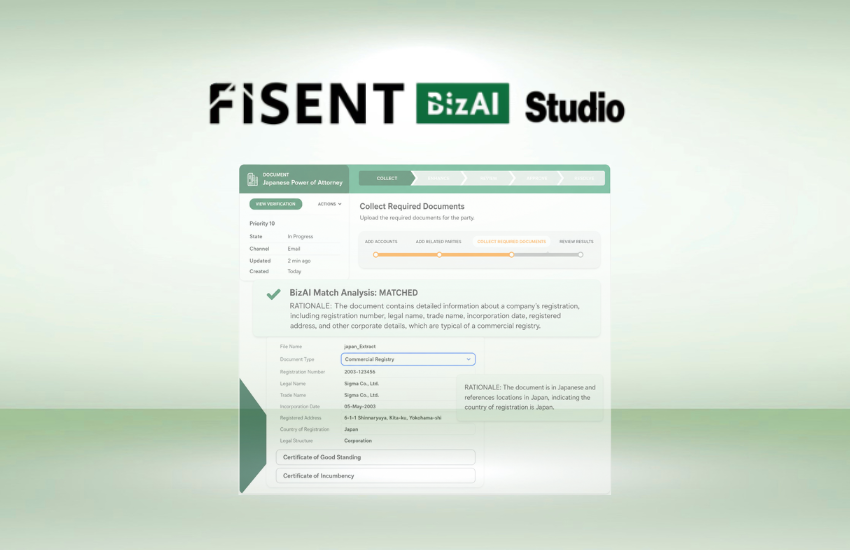
Branded content with Fisent Technologies
An enterprise-ready content automation platform that helps Pega teams automate document, email, and unstructured content workflows with AI-driven content intelligence.
Key Takeaways
- Pega workflows are often automated, but the content inside them is not
- Manual document handling still creates major operational overhead
- Fisent BizAI Studio introduces a dedicated Studio experience for content automation
- BizAI can classify, extract, verify, analyze, and structure enterprise content
- The platform integrates naturally into existing Pega workflows
- Enterprise-grade security, governance, and zero-retention are built into the platform
Pega is excellent at workflow automation.
Most Pega teams can take a complex business process and translate it into case types, stages, steps, assignments, SLAs, integrations, approvals, and decisioning logic.
With Pega Blueprint, even the early stages of process discovery and application design are becoming faster. Business teams can describe a process, visualize it, and quickly see how the application could be structured.
But even when the workflow is well designed, one part of the process can still slow everything down.
The content.
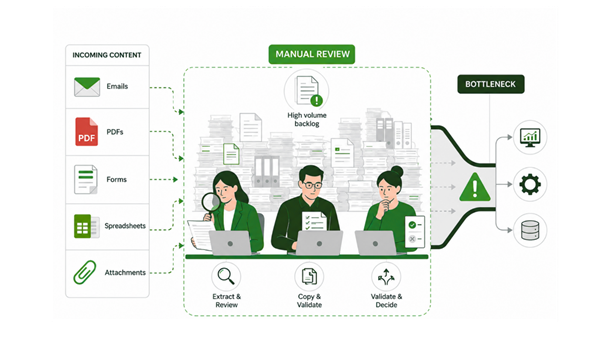
Emails, PDFs, spreadsheets, forms, images, and supporting documents still need to be understood before the case can move forward.
In many enterprise applications, the process looks digital from the outside. The case is created, the assignment is routed, the SLA is running, and the dashboard shows progress.
But behind that clean workflow, there is often a very manual reality.
A customer sends an email with attachments. A PDF contains multiple documents. A spreadsheet has important details hidden in rows. A form is incomplete. A supporting document needs to be checked before the next step can happen.
At that moment, automation usually pauses.
Not because the workflow is broken. But because the content needs human interpretation.
Someone has to open the file, understand what it is, extract the right information, check whether it is valid, and decide what should happen next. When this happens across hundreds or thousands of cases, it becomes a serious operational bottleneck.
This is where Fisent BizAI becomes highly relevant for Pega customers, especially with the launch of Fisent BizAI Studio.
When Manual Content Work Becomes an Operations Team
This problem is not theoretical.
In one recent conversation with a Pega colleague, I heard about a large bank using Pega where around 70 to 80 people were involved in backend document processing. Their role was not to build or use automations using Pega. They were mainly handling documents manually as part of the business process.
That stayed with me.
“The workflow automation is there, but the document understanding is still sitting with a large operations team.”
This is the point where content processing stops being a small task and becomes a real cost center.
It affects turnaround time. It affects consistency. It affects customer experience. It also limits how far the organization can actually go with automation.
Pega may be routing the work efficiently, but if a large team still needs to manually interpret the documents before the case can move forward, there is still a major automation gap.
“Our business is the discipline of turning unstructured content into automated outcomes.”
Adrian Murray, Founder and CEO of Fisent Technologies
That is a strong way to describe the opportunity.
The goal is not just to read documents.
The goal is to turn content into something the business process can actually use.
What Fisent BizAI Brings to the Workflow
This is where Fisent BizAI becomes interesting.
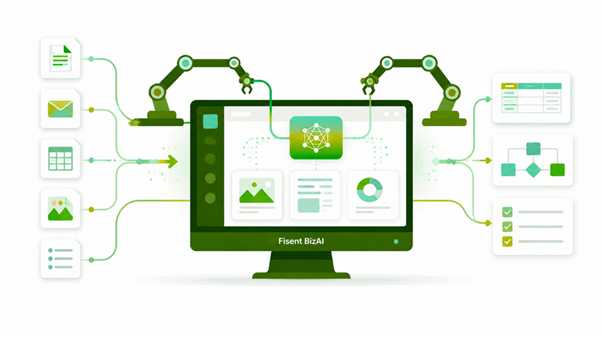
It is not just another document extraction tool sitting outside the process. It is designed to take unstructured content and convert it into outputs that a business workflow can actually use.
That content can be a document, email, spreadsheet, image, form, or even a collection of files submitted together. BizAI can process that content and return structured information that can be used by downstream systems, including Pega.
“Pega brings the structured business workflow. We bring the content intelligence layer.”
Adrian Murray, Founder and CEO of Fisent Technologies
That line explains the fit well.
Fisent BizAI is not trying to replace the workflow layer. It is focused on the content layer. The value is in helping the workflow understand what came in, what matters, what is missing, what can be trusted, and what should happen next.
This is why the combination makes sense for Pega customers. Pega can continue to orchestrate the work, while BizAI handles the content intelligence that often slows the work down.
Why This Is Different From Traditional OCR
When people hear document automation, they often think about OCR. OCR is useful, but its role is mostly to read text from a document.
That is only the starting point.
In real enterprise processes, the business usually needs more than text. It needs context, validation, interpretation, and confidence.
Take a Power of Attorney document as an example. Extracting the name and date is useful, but it may not be enough. The business may also need to know whether the document contains authority language, whether execution requirements are met, whether the document appears valid, and whether it can be accepted for a specific process.
That is not simple extraction.
That is content understanding.
Fisent BizAI is designed around this higher-value layer. It can help classify the content, split complex files, extract structured data, tabulate rows and tables, verify business conditions, and analyze the meaning of the content.
So the question is not only: “What text is present in the document?”
The more important question is: “What does this content mean for the business process?”
That is the important difference.
Fisent BizAI Studio: A Dedicated Studio for Content Automation
One of the most important recent updates from Fisent is the launch of Fisent BizAI Studio.
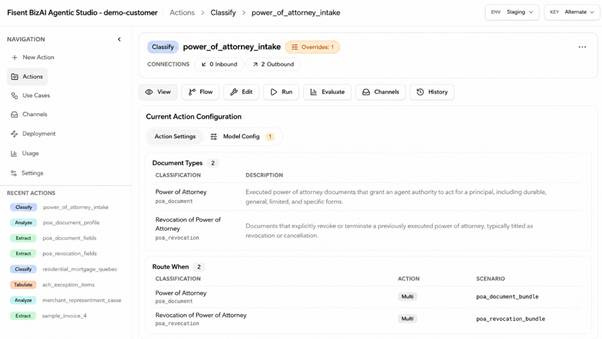
For Pega professionals, this is an easy concept to relate to because we are already used to working with different studios. App Studio helps teams design applications and workflows. Dev Studio supports deeper rule configuration. Prediction Studio supports AI and decisioning capabilities.
Fisent BizAI Studio can be seen as a dedicated studio for content automation.
If Pega App Studio is where you configure the workflow, Fisent BizAI Studio is where you can configure how enterprise content should be understood.
That separation is important. Content automation has its own complexity. Documents, emails, spreadsheets, images, and supporting evidence all behave differently. They may require different actions, data structures, validation logic, confidence checks, model evaluations, and deployment controls.
This is where BizAI Studio becomes interesting for Pega teams. Instead of treating content automation as a custom integration or hidden technical layer, the Studio gives teams a dedicated place to design, test, evaluate, and manage how content should behave inside business workflows.
What Pega Developers Can Configure Inside BizAI Studio
For Pega developers and architects, the most useful way to look at BizAI Studio is not as another generic AI tool. It is a design environment for the content layer of your enterprise process.
Inside the Studio, teams can design content automation agents that define how content should be classified, what information should be extracted, what business questions should be verified, and what analysis should be returned to the workflow.
For example, a content automation may need to identify whether a document is a bank statement, invoice, claim receipt, Power of Attorney, or customer email. Once identified, it may need to extract specific fields, verify if required information is present, and analyze whether the content satisfies the business requirement.
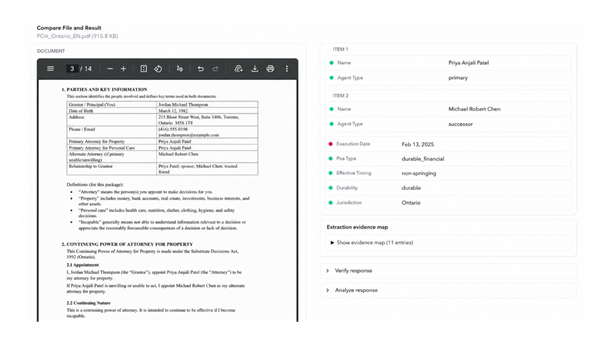
This is where actions such as classify, split, extract, tabulate, verify, and analyze become relevant. They are not just feature names. They represent the manual steps that users often perform today when they open documents and emails inside a case.
The important point is that these actions can be modeled in the Studio and then reused inside enterprise workflows.
That makes the Studio valuable for Pega teams. The workflow can remain in Pega, but the content automation logic can be designed and managed in BizAI Studio.
From BizAI Studio Back to the Pega Workflow
Once the content automation is configured in BizAI Studio, the runtime pattern with Pega is quite natural.
A case is created in Pega, and the customer submits an email, PDF, spreadsheet, image, or other content. At the right step in the workflow, Pega invokes Fisent BizAI using an API built using the available Pega Marketplace component.
Fisent BizAI processes the content based on the actions configured in BizAI Studio. It then returns structured output, usually as a JSON response.
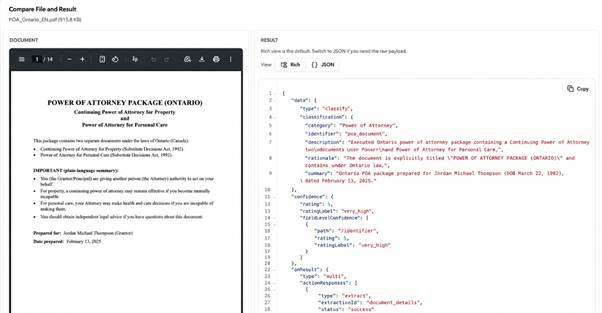
Pega can map that response into the case data model. From there, Pega continues with rules, routing, SLAs, decisions, approvals, exception handling, or user review.
This is where the separation becomes powerful. Pega handles the orchestration. BizAI Studio defines how the content should be interpreted.
“Pega gets to act as the orchestration layer.”
Adrian Murray, Founder and CEO of Fisent Technologies
That keeps the responsibilities clear. Pega decides when content intelligence is needed inside the workflow. BizAI performs the content automation at that point.
For implementation teams, this can reduce friction. They do not need to build an entire content automation platform from scratch. The content automation layer can be configured in BizAI Studio and invoked from Pega when required.
Where This Studio-Led Approach Can Help
This Studio-led approach is especially relevant where Pega workflows depend on documents, emails, spreadsheets, forms, or supporting evidence.
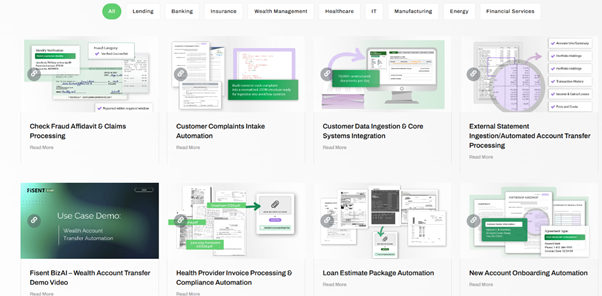
KYC and customer onboarding is one natural area. Banks and financial institutions receive many document types in different formats and languages. Pega can manage the onboarding journey, while BizAI Studio can help define how those documents should be classified, extracted, verified, and analyzed.
Lending is another strong fit. Loan applications often include bank statements, financial records, contracts, forms, emails, and supporting evidence. BizAI can prepare this content so Pega can drive the lending workflow more efficiently.
Insurance is also very relevant. Claims and underwriting processes depend heavily on forms, photos, invoices, reports, customer emails, and supporting documents. BizAI can support the interpretation of this content while Pega manages the claim or underwriting lifecycle.
Legal and operations processes can also benefit. Documents such as Power of Attorney files, contracts, agreements, and compliance evidence often need more than simple extraction. They need business-level interpretation and validation.
Airline claims also come to my mind immediately. Customers may submit receipts, itineraries, hotel invoices, disruption emails, medical documents, compensation requests, and bank details. Pega can manage the claim journey, while BizAI can help understand and structure the submitted content.
The pattern is not limited to one industry. Wherever there is a Pega workflow with heavy manual content review, there may be an opportunity to improve the process with Fisent BizAI Studio.
Trust and Security Matter in Enterprise AI
When AI is used in enterprise workflows, the demo is only the beginning. The real evaluation starts when customers ask the important questions.
“Where does the data go? Is the content stored? Is it used for training? How is it encrypted? Can the outputs be trusted? Can the process stand up to security and compliance review?”
These questions matter even more in industries like banking, insurance, healthcare, government, and other regulated environments, where the content being processed is often highly sensitive.
This is also where Fisent’s customer footprint becomes relevant. Fisent BizAI is already being used in environments such as financial services and nuclear energy, where trust, security, governance, and operational reliability are not optional. They are part of the entry criteria.
This is one of the reasons Fisent BizAI stands out as an enterprise-ready platform. Fisent’s trust and security approach includes controls such as SOC 2 Type II compliance, encryption, access controls, continuous compliance monitoring, accuracy tracking, and zero retention.
The zero-retention approach is especially important. Fisent states that client data processed through BizAI is not retained or used for training. For enterprise customers, that is not a small detail. It is a major requirement.
Many of the documents flowing through Pega workflows contain customer information, financial data, legal content, identity documents, medical details, or sensitive operational information. If AI is going to process that content, trust and security have to be built into the solution from the start.
That is what makes this conversation bigger than just automation. It is also about confidence.
How to Reach Fisent
If your Pega project involves heavy document processing, email review, content analysis, or manual back-office operations, Fisent BizAI is definitely worth exploring.
The best place to start is fisent.com, where you can learn more about the platform and book a demo with the Fisent team.
If you are specifically interested in the newly launched Fisent BizAI Studio, I would strongly recommend asking for a live walkthrough. That is where the value becomes much clearer. Once you see how content automation can be configured, evaluated, and connected back into a workflow, the practical relevance becomes much easier to understand.
Fisent is also active on LinkedIn, so following their official page is a good way to stay updated on product announcements, Studio updates, customer stories, and upcoming events.
If you are attending PegaWorld, keep an eye on Fisent there as well. They are expected to bring some interesting conversations and activity around content automation, and that makes it a good opportunity to see the platform in context.
Final Thought
Pega has always been strong at enterprise workflow automation. It helps organizations manage cases, route work, apply rules, track SLAs, guide users, and orchestrate complex business processes at scale.
Fisent BizAI Studio does not change that story.
It complements it.
Where Pega manages the workflow, Fisent BizAI Studio helps define how the content inside that workflow should be understood, validated, and turned into structured information the process can use.
That is what makes the combination interesting for Pega teams.
It is not about replacing one layer with another. It is about bringing workflow automation and content automation closer together.
With the launch of Fisent BizAI Studio, this becomes much more tangible. Pega developers, architects, and enterprise teams now have a dedicated content automation studio they can work with alongside the Pega studios they already know.
For organizations still relying on heavy manual document processing, this can be a meaningful step forward.
Pega orchestrates the workflow. Fisent BizAI Studio helps automate the content work inside it.