


Every architect should be doing one thing consistently before any implementation decision – trade-off analysis.
It sounds obvious. But in my experience, this is where a lot of practitioners fall short. They default to what they know, what they have used before, or what their organisation has already invested in. That is not architecture. That is habit.
Real architectural thinking starts with comparison. And comparison requires trade-offs.
Why trade-offs matter more than you think
Before a single line of Pega code is written, your enterprise and solution architects are already making trade-offs. The very first one is platform selection. Which platform fits this organisation? Pega, Salesforce, ServiceNow, Mendix, Camunda? There are many more.

In banking alone, you will find different organisations using completely different tools for the same type of workflow automation. And that is perfectly fine. There is no single correct platform.
The right choice depends on what your organisation values – maintainability, scalability, cost, updatability, low-code capability, adaptability. The full list of “-ilities.” These characteristics, weighted against the organisation’s specific context, are what should drive platform decisions – not familiarity, not vendor preference, not what the previous CTO chose.
The trade-off process is what forces you to be honest about that.
The trade-off does not stop after platform selection
Let’s say Pega is chosen. Most people think the hard decisions are behind them. They are not.
Now you move into software architecture. What are your architecture layers? How will the application be deployed – cloud, on-premise, client-managed cloud? What does your CI/CD pipeline look like? How are your teams structured? Who owns which layers?
These are not application design questions. They are architectural decisions. And every one of them involves trade-offs – between speed and control, between flexibility and standardisation, between cost and resilience.
Once those decisions are made, you move into application design. And this is where many of you reading this will be directly involved.
Architecture and design are not the same thing
I see these two terms used interchangeably all the time. They are not the same.
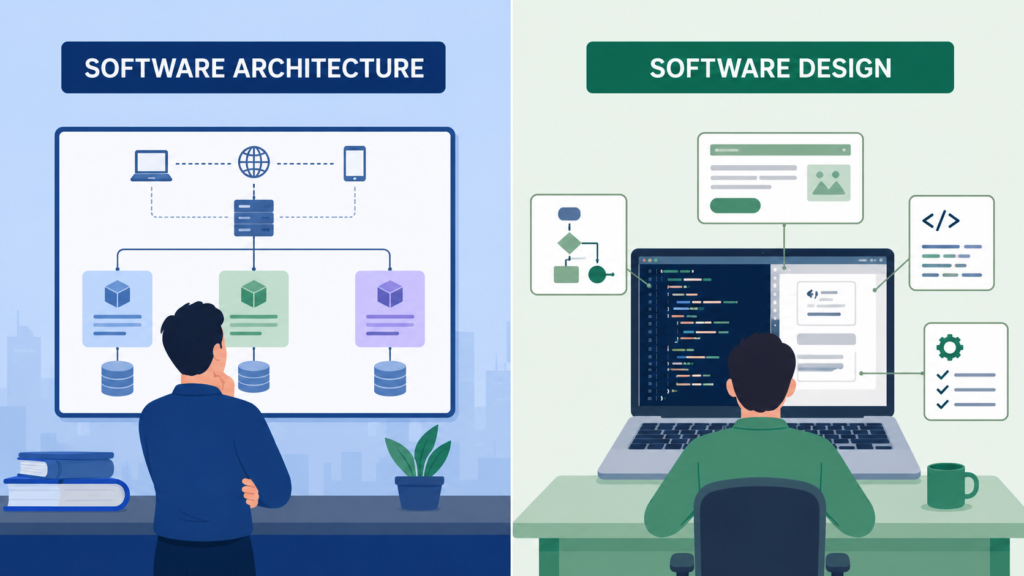
Think about building a house. Before any interior or exterior design starts, you need the architectural plan. How many floors? Where do the load-bearing walls go? What is the foundation type? Those structural decisions determine what is even possible in the design phase. Get the architecture wrong and no amount of good interior design will fix it.
Software development works the same way. The architect’s job is to define the structure – class hierarchy, reusability model, data architecture, integration patterns, deployment topology – before application design begins. That structure constrains and enables everything that comes after it.
Skipping the architecture and jumping straight into design is one of the most common mistakes on Pega projects. You end up with a well-designed application built on a weak foundation.
Blueprint accelerates design phase
Designing Pega applications today is genuinely much easier than it was a few years ago. Blueprint has changed how teams approach application design – you can take a case study, run it through Blueprint, and get to a structured design much faster than before.
But here is what Blueprint does not do – it does not make your architectural decisions for you. (Atleast as of June 2026, as I penned down this article)
Before you open Blueprint, you need to have already worked out your architecture styles. You need to know which applications share data and which are isolated. You need to understand your reusability model – what is common across the enterprise versus what is specific to a line of business. You need your integration and data architecture defined at least at a high level.
Blueprint is a powerful tool for translating good architecture into a working design. If the architecture has not been thought through first, Blueprint will just help you build the wrong thing faster.
Coming back to architecture – the decisions that matter most
Once you are inside a Pega engagement and moving toward application design, there are a handful of architectural decisions that consistently make or break the outcome.
Class structure and reusability are the most critical. How you design your class hierarchy determines how much you can share across case types, channels and business units. Get this wrong and you spend years working around a rigid structure that was never designed for growth.
Data architecture is the next one. Where does data live? What is Pega the system of record for, and what is it pulling from elsewhere? How are your data pages structured? These decisions affect performance, integration complexity and maintainability for the life of the application.
Deployment and environment strategy matters more than people give it credit for. Who controls the infrastructure? How are rulesets versioned and promoted? What does branching look like in a team of ten versus a team of fifty?
None of these questions answer themselves. They require deliberate thought, comparison of options, and – yes – trade-offs.
Trade-offs are how you make better decisions
We all do trade-off analysis in everyday life without labelling it. Buying a car, you test drive a few before committing. Buying a house, you view several before making an offer. You weigh the options, look at the pros and cons honestly, and then decide.
The same discipline applies to every architectural decision in a Pega engagement. The mistake most people make is skipping the comparison phase and going straight to a conclusion. That might feel efficient. But it usually means you are just picking the first option that came to mind, not the best one for the situation.

Documenting trade-offs matters too. When you write down your options, your criteria, and why you chose what you chose, it creates a record. A year later, when someone questions a decision, you have the reasoning. When requirements change, you can revisit whether the original trade-off still holds.
The architect in you
Whether your title says architect or not, if you are involved in Pega application design, you are making architectural decisions. The question is whether you are making them deliberately or by default.
Trade-off analysis is the discipline that separates the two.
Next time you face a design decision – class structure, data page strategy, integration pattern, deployment approach – stop before you default to what you know. List the options. Weigh the criteria. Be honest about the downsides of each. Then choose.
That is what the architect in you should be doing.