

We often celebrate our personal milestones – certifications, promotions, successful implementations and project achievements.
Sometimes it is equally important to pause and celebrate the achievements of the platform and ecosystem that have shaped many of our careers.
And this is certainly one of those moments for the Pega community 😊
Pegasystems has earned a Leader position in two major analyst reports: The Forrester Wave: AI Platforms, Q3 2026 and The 2026 Gartner Magic Quadrant for Business Orchestration and Automation Technologies.
For professionals who follow enterprise technology, terms such as Forrester Wave and Gartner Magic Quadrant may already be familiar.
But if you are seeing these reports for the first time, you may wonder:
Is this simply another ranking published by an external company?
It is much more than that.
Let us break it down in simple terms and understand why these recognitions matter, not only to Pegasystems but also to customers, partners and professionals working across the Pega ecosystem.
First, who are Forrester and Gartner?
Forrester and Gartner are two of the world’s most prominent technology research and advisory firms.
They study technology markets, identify emerging trends, evaluate vendors and publish research that helps organizations make informed decisions.
Depending on the category, analysts look at areas such as product capabilities, strategy and vision, innovation and roadmap, governance and architecture, customer feedback, support for enterprise use cases, and the vendor’s execution and market presence.
Each firm uses its own evaluation model. Two of the most widely recognized formats are The Forrester Wave™ and The Gartner® Magic Quadrant™.
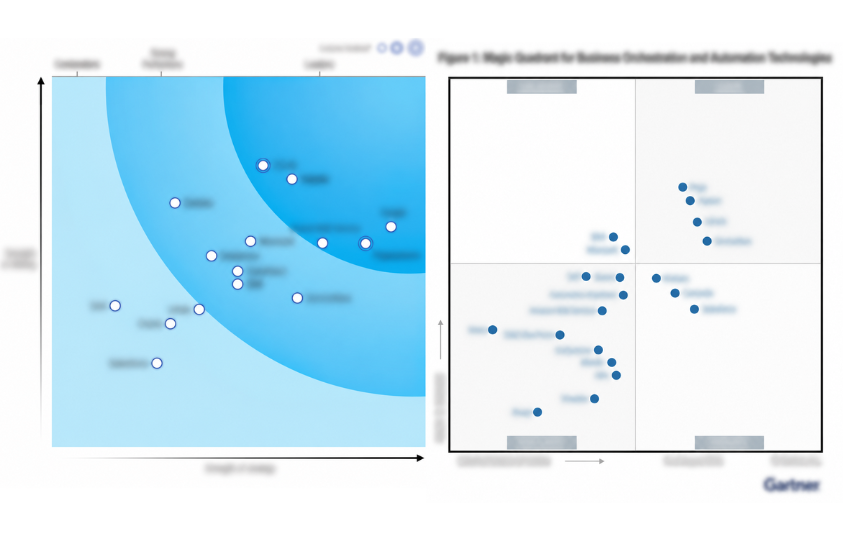
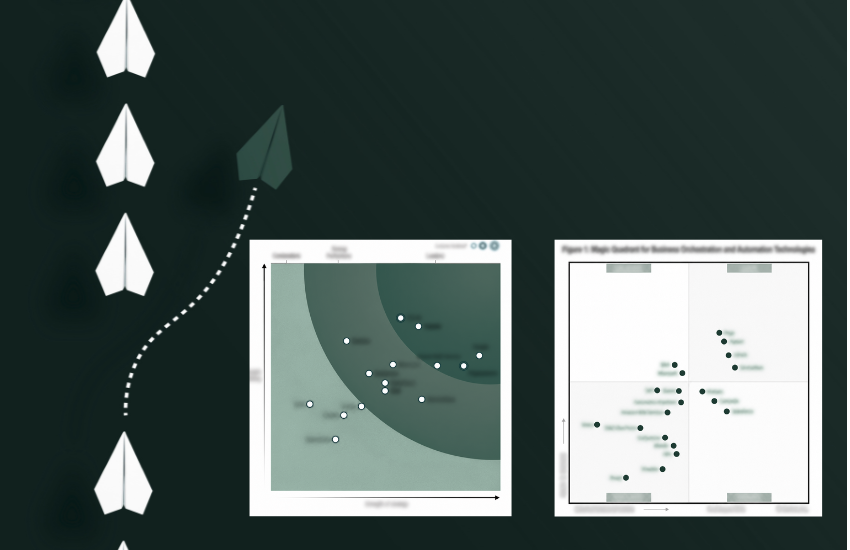
The visuals may look simple, but they represent a much broader research and evaluation process.
Why do enterprises use analyst reports?
Banks, insurers, airlines, healthcare providers and government agencies make significant investments when they select an enterprise platform. That choice can shape their architecture, operating model and technology spend for many years.
Analyst research adds an external perspective. CIOs use it to support the business case they present to leadership or the board. Enterprise architects use it as one input when comparing platforms.
It also helps teams follow how markets are changing, especially now that AI, automation, low-code and orchestration overlap. Some organizations even require documented market research in their procurement and governance processes.
Enterprises pay for this research through subscriptions and analyst access. Vendors can buy reprint rights to share the reports, but they cannot buy their position.
None of this replaces a proper evaluation of the organization’s own requirements. It simply adds a wider market view.
An analyst report is a valuable input into a technology decision, not a replacement for architectural judgment.
Pega named a Leader in The Forrester Wave™ for AI Platforms
In August 2026, Forrester published The Forrester Wave™: AI Platforms, Q3 2026.
Here, Q3 2026 refers to the quarter in which Forrester published the report. It does not mean Forrester runs the same evaluation every quarter.
The report evaluated 15 vendors: Amazon Web Services, C3 AI, Databricks, Dataiku, DataRobot, Google, IBM, Microsoft, Oracle, Palantir, Pegasystems, Salesforce, SAS, ServiceNow and UiPath.
That is an impressive field. It includes hyperscalers, data and AI specialists, enterprise software companies and automation platforms.
Forrester explained that agentic AI has changed the boundaries of this market. The evaluation now goes beyond data, models and insights. It also looks at how platforms understand context, navigate workflows and turn intelligence into completed work.
That shift plays directly to Pega’s strengths. Forrester named Pega a Leader, highlighting workflow automation, decisioning, personalization, governance and support for complex, regulated workflows. Pega Blueprint evolution has definitely played its part!!
Seeing Pega recognized alongside Google, AWS, Microsoft, Salesforce, IBM, Oracle and ServiceNow is certainly a proud moment for the ecosystem.
You can read Pega’s summary and request access to the report here:
The Forrester Wave™: AI Platforms, Q3 2026
Pega remains a Leader in the Gartner® Magic Quadrant™ for BOAT
The next recognition comes from Gartner.
Gartner introduced the category of Business Orchestration and Automation Technologies, commonly known as BOAT.
Organizations have traditionally used separate tools to automate work: business process automation, robotic process automation, low-code development, workflow orchestration, integration and AI-powered decisioning. BOAT reflects the convergence of these capabilities into platforms that orchestrate work across people, systems, automation and AI.
In September 2026, Gartner published its latest Magic Quadrant for BOAT, evaluating 20 vendors.
Gartner named Pega a Leader for the second consecutive year.
Second time in a row, definitely something worth celebrating! 😊
Case management, workflow, business rules, decisioning, integrations, robotics, low-code and AI have long lived together in the Pega platform.
With AI agents joining the enterprise workforce, orchestration matters even more. An agent can reason or recommend an action, but the enterprise still decides what it may do, which systems it can access, when a human stays involved and how every decision is governed and audited.
That is where workflow and orchestration platforms play a major role.
You can read Pega’s summary and request access to the report here:
2026 Gartner® Magic Quadrant™ for BOAT Platforms
What do these recognitions mean for Pega customers?
An analyst recognition should never be read as:
“Pega is a Leader, so every organization should automatically choose Pega.”
The correct interpretation is more thoughtful.
It tells customers that independent analysts have evaluated Pega as one of the significant vendors in these markets.
It gives technology leaders another credible input when they evaluate Pega for complex and regulated workflows, AI-powered decisioning, customer engagement, application development, process orchestration and governed agentic automation.
Every customer must still assess whether the platform fits its own business problems, architecture, skills, costs, operating model and long-term strategy.
But a Leader position gives Pega a strong place in those conversations.
What does it mean for Pega professionals and partners?
For those of us who have built our careers around Pega, these reports mean more than a marketing headline.
They confirm that the capabilities we work with, from case management, workflow, decisioning, automation and governance to Blueprint and agentic AI, remain highly relevant to the direction of enterprise technology.
They also give us a responsibility.
We should be able to explain Pega beyond individual rules and features. We need to show customers how Pega connects AI with real business processes, how orchestration creates measurable outcomes and how governance can be built into automation from the start.
Partners can use these reports to open valuable conversations with customers.
A proud moment for the Pega ecosystem
Over the coming weeks, these reports will appear regularly across LinkedIn and other Pega community channels.
And I feel, we should share them.
We should celebrate the teams within Pegasystems who keep developing the platform capabilities, and celebrate the customers, partners, architects, developers, business analysts and community contributors who turn those capabilities into real outcomes.
Analyst reports will continue to evolve. Market categories will change. Vendor positions can move.
But for this moment, seeing Pega recognized as a Leader in both AI Platforms and Business Orchestration and Automation Technologies is an achievement worth acknowledging.
As a Pega professional, it certainly feels good to see the platform standing strong among some of the biggest technology companies in the world.
Congratulations to Pegasystems and everyone contributing to the Pega ecosystem.
For Pega, cheers! 🥂