


Salesforce and Anthropic recently announced Claudeforce.
When I first saw the name making headlines, my immediate reaction was:
Is there an acquisition on the table? If so, that would be huge!
But no – it is a strategic partnership bringing Claude’s reasoning capabilities together with Salesforce’s existing enterprise data, workflows, business rules, and governance.
Interesting announcement, certainly.
But as a Pega professional, what caught my attention was not the Salesforce functionality itself.
It was the underlying message:
AI intelligence alone is not enough to run an enterprise. It still needs deterministic workflows, trusted business rules, governance, and reliable execution underneath.
For anyone familiar with Pega, does that message sound new?
This is exactly where Pega has always been strong.
For decades, Pega has helped enterprises place business rules, decisions, workflows, case management, and governance at the heart of their mission-critical operations.
Now, as AI agents and MCP reshape how users interact with applications, those foundational capabilities are becoming even more valuable.
This article is heavily inspired by the latest Reality Check post from Don Schuerman, CTO of Pegasystems. If you want to stay close to AI advancements in the Pega ecosystem, keep a close watch on his posts. They regularly contain valuable insights and plenty of food for thought.
Rather than breaking down every Claudeforce capability, I want to discuss what this announcement quietly confirms about the future of enterprise AI, and why Pega may be better positioned for that future than many people realize.
1. AI is not going to kill serious enterprise platforms
For the past year, we have repeatedly heard that AI agents and MCP will make SaaS and enterprise platforms irrelevant.
There is some truth behind the argument.
AI-assisted coding is already making it easier to recreate simple applications with a few screens, a database, and limited business logic. Some smaller software categories will certainly face pressure.
But platforms such as Pega are not merely collections of screens sitting on top of a database.
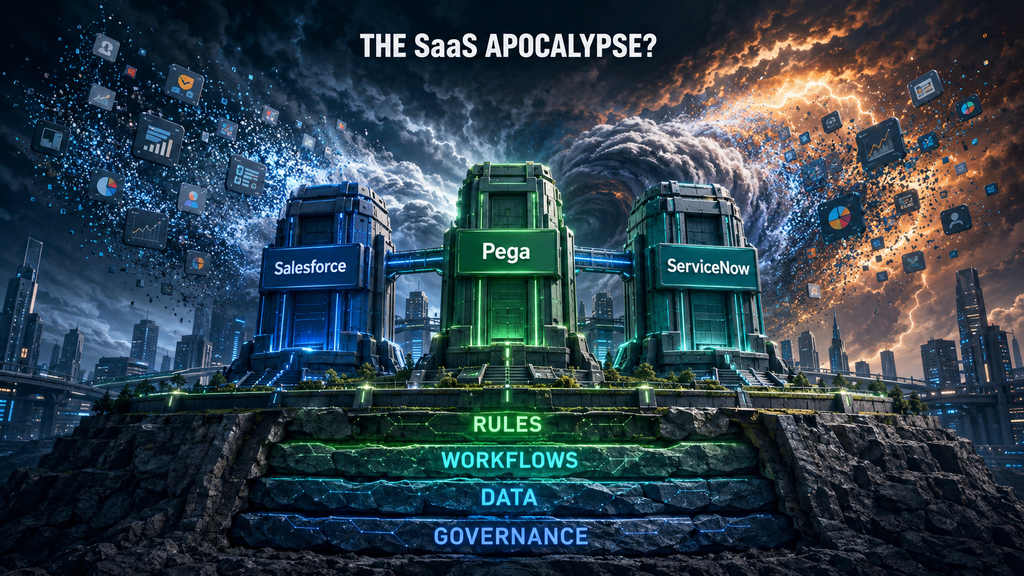
Pega applications can hold years, sometimes decades, of business rules, case management logic, decisioning strategies, and approval hierarchies. Add to that security and authorization controls, service level commitments, integration logic, regulatory requirements, exception handling processes, and audit history, and you start to see the depth involved.
You cannot safely replace all of that with a clever prompt and a collection of tools.
This is particularly important for the business processes that Pega is designed to run.
A large language model is probabilistic. It is excellent at understanding intent, interpreting unstructured information, generating content, and reasoning through uncertainty.
But enterprises cannot allow every compliance check, financial calculation, eligibility decision, or authorization rule to be interpreted differently each time a prompt is submitted.
They need deterministic execution.
And this is where the Claudeforce announcement sends a strong message.
After all the talk about AI replacing enterprise platforms, AI still needs an enterprise platform to make its reasoning operational.
For Pega professionals, this should not come as a surprise.
Pega has always separated the experience from the business logic underneath it. Channels may change, interfaces may evolve, and new technologies may appear, but the rules and workflows remain centrally governed. This architecture is there before AI entering the limelight!!
AI does not weaken that architecture.
It makes the architecture even more relevant.
2. AI is becoming another front door to Pega
The more interesting shift is happening at the experience layer.
Traditionally, users opened an application, navigated through menus, found the correct case, and completed work through predefined screens.
AI agents are beginning to change this interaction model.
Instead of knowing which application or screen to open, a user can explain the business outcome they want:
“Review my pending claims and show me the ones that require urgent action.”
“Start a complaint for this customer and include the conversation history.”
“Find the delayed requests, identify the cause, and assign the appropriate follow-up work.”
The AI can understand the intent.
But Pega can still control how the work is performed.
This is where the Pega Agent Experience API, MCP, A2A, and Pega Agentic Process Fabric become strategically important.
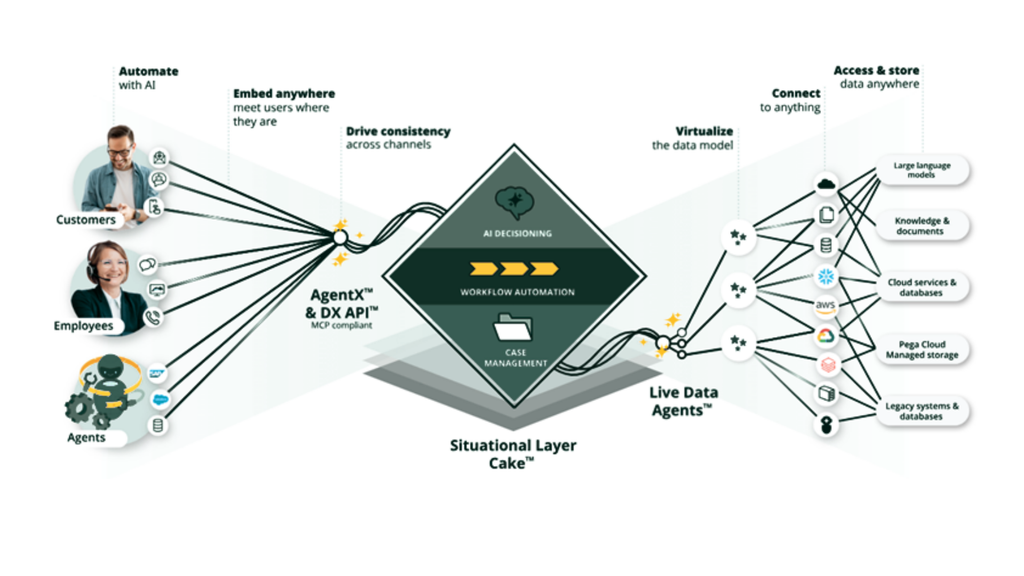
Pega workflows can be made available to AI-powered experiences without moving the actual business logic into free-text prompts.
An external agent can discover an approved Pega capability, supply the required context, and initiate a governed workflow.
Pega then handles the reliable execution underneath. Which case should be created, which rules must run, what information is required, who should receive the assignment, which approvals are necessary, which integrations must be invoked, and what must be recorded for auditing.
The agent becomes the new front door.
Pega remains the process and governance engine behind that door.
That is a powerful combination.
3. The UI will evolve, but it will not simply disappear
Some of the current messaging in the market suggests that AI will become the UI.
It is a powerful statement, and it works well, but enterprise reality is usually a little more complicated.
AI will certainly become an important interface.
It will be excellent for finding work, summarizing cases, interpreting requests, planning activities, and initiating the correct workflows.
But structured user interfaces will continue to matter.
Consider a loan application, insurance claim, healthcare intake, or regulatory review.
The organization may require specific mandatory information, validated dates and numerical values, and standardized selections. It may also need supporting documents, legally required disclosures, explicit customer consent, and human review and confirmation.
You could collect some of this conversationally.
But at certain points, a structured UI may still be the clearest, safest, and most efficient experience. I don’t want to imagine having those security layers completely in AI 😉
So I do not see the future as AI versus UI.
I see the two complementing each other.
A user may start conversationally. The AI can understand the intent and gather the initial context. Pega can then present a structured view when precise data, validation, or confirmation is required.
Once that step is complete, the agent can continue orchestrating the journey.
The experience may move between conversation, generated interfaces, structured Constellation views, APIs, and background automation.
But the same Pega workflow can remain underneath all of them.
Pega was built for this architectural shift
This is where the Pega story becomes particularly strong.
Pega already has many of the essential building blocks.
- Pega Blueprint to reimagine and design workflows.
- Center-out architecture to centralize business logic and make it reusable.
- Pega Agent Experience API to turn workflows into agentic experiences.
- MCP and A2A support to connect with the wider agent ecosystem.
- Pega Agentic Process Fabric to orchestrate agents, workflows, applications, systems, and data.
- Predictable AI Agents that combine conversational AI with approved workflow execution.
- Constellation and DX APIs to deliver API-driven experiences. And underneath all of it, a mature rules, decisioning, case management, and workflow foundation.
The AI model may change.
Today, an enterprise may choose Claude. Tomorrow, it may choose another frontier model, or use multiple models for different purposes.
The primary interface may change as well.
Users might work through a Pega application, a mobile channel, Microsoft Copilot, Claude, or another enterprise agent.
But the organization still needs a stable foundation for its business rules, decisions, workflows, security, and governance.
Pega does not need to be the only interface.
It needs to remain the trusted engine that ensures the work gets done correctly, regardless of where the request begins.
What should Pega professionals do?
For Pega professionals, the Claudeforce announcement is not simply news about a competing platform.
It is further confirmation of the direction in which enterprise architecture is moving.
When designing Pega applications, we should no longer think only about people navigating portals and screens.
We should also ask how an AI agent can discover this workflow, which Pega capabilities should be exposed as governed tools, and which actions must remain deterministic. Where is human confirmation required? How should authorization work across AI channels? Can the same workflow support UI, API, and agent driven interactions? And how will every action remain observable and auditable?
This does not reduce the need for strong Pega skills.
It makes those skills more valuable.
Business rules, case management, data modelling, integrations, security, and workflow design remain fundamental. But Pega architects must now connect that depth with agentic architecture, MCP, A2A, AI governance, and new interaction patterns.
The interface is changing.
The need for well-designed enterprise processes is not.
Final thoughts
Claudeforce is certainly an interesting announcement.
But for me, the bigger takeaway is not about Claude or Salesforce individually.
It is the recognition that probabilistic AI intelligence must be combined with deterministic enterprise systems.
AI can understand, reason, generate, and recommend.
But when the enterprise needs to execute something reliably, it still requires trusted data, approved workflows, business rules, security, governance, and auditability.
That is not a weakness of enterprise platforms.
That is precisely their value.
And it is where Pega has spent decades building its strength.
So after a year of hearing that AI might replace enterprise platforms, the message now appears to be changing:
AI may become the new front door, but it still needs a reliable enterprise engine behind it.
Pega can be that engine.
With Blueprint helping to reimagine workflows, Center-out architecture keeping business logic reusable, and Agent Experience API, MCP, A2A, and Agentic Process Fabric opening Pega to the agentic ecosystem, the direction looks increasingly clear.
Maybe the industry is not moving beyond workflow platforms after all.
Maybe it is finally discovering why governed workflows mattered in the first place.