
Application modernization is not a new topic.
For years, almost every large organization has discussed cloud adoption, reducing technical debt, replacing legacy applications, and freeing itself from technologies that are becoming increasingly expensive and difficult to maintain.
There have also been many modernization tools and innovative solutions in the market.
But when AI entered the room, the modernization conversation moved much further ahead.
It is no longer only about migrating an old application to a new technology stack.
The more interesting question is this:
Can AI understand what the legacy application does, recover the business knowledge hidden inside it, and help us reimagine the process as a modern application?
This is where the strategic collaboration between Pega and AWS becomes very interesting.
Most Pega professionals already know what Pega Blueprint can do. When we provide the right business requirements and supporting artifacts, Blueprint can rapidly produce a structured application design containing case types, stages, personas, data objects, and other important building blocks.
This article is not another explanation of Blueprint features.
Instead, I want to discuss how AWS Transform and Pega Blueprint are coming together to create a much more powerful modernization journey.
The long-standing partnership between Pega and AWS
Pega and AWS have worked together for more than a decade.
AWS has been the preferred cloud provider for Pega Cloud, supporting the infrastructure required to run mission-critical Pega applications at enterprise scale.
The relationship became even more important with the arrival of generative AI.
Pega uses managed AI services such as Amazon Bedrock as part of its wider GenAI architecture. Pega also supports AI models and providers through a managed abstraction, allowing the platform to use the right supported model without every application team having to manage the underlying model integration independently.
The exact models available can change across releases and regions, so Pega now provides a Model Availability Dashboard for checking the currently supported options.
Amazon Bedrock and Pega GenAI definitely deserve a separate article of their own.
But the partnership now goes beyond consuming foundation models.
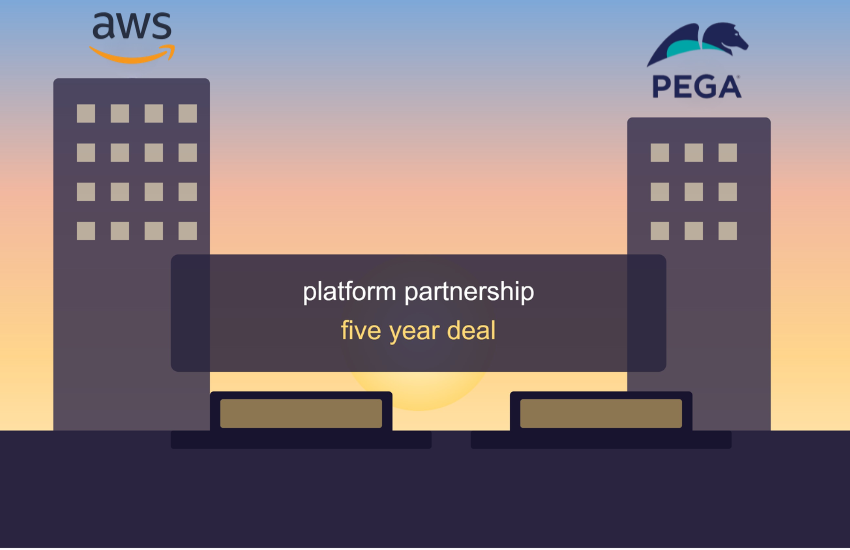
In July 2025, Pega announced a five-year Strategic Collaboration Agreement with AWS , with a major focus on using generative and agentic AI to accelerate legacy transformation.
The central combination behind this modernization story is simple: AWS Transform plus Pega Blueprint.
First, what is AWS Transform?
AWS Transform is an agentic AI service for modernizing enterprise technology. It uses specialized AI agents to assist with activities such as analysing legacy code, discovering application dependencies, extracting business rules, producing technical documentation, planning modernization activities, refactoring or transforming code, supporting testing and validation, and assisting with cloud migration.
Let us take a simplified example.
Imagine that a bank is still operating a 30-year-old mainframe application built using COBOL and DB2.
The application may continue to perform an important business function. But many of the original developers may have left the organization, the available documentation may be incomplete, and thousands or even millions of lines of code may contain decades of accumulated business logic.
Before replacing the application, teams must answer some difficult questions.
What does this code actually do? Which business rules are hidden inside it? Which programs and data structures depend on one another? Which behaviours must be preserved, and which are no longer required? How can the application be modernized without disrupting the business?
Traditionally, answering these questions can require months of manual analysis.
AWS Transform uses specialized AI agents to accelerate this discovery and modernization work.
For a mainframe workload, it can analyse the legacy estate, extract business rules, identify dependencies, generate documentation, and support the planning and transformation of the application.
Very simplistically, AWS Transform takes the legacy application, analyses the existing code and dependencies, extracts the business rules, processes and data structures, builds a structured understanding of the existing system, and prepares the workload for transformation.
AWS Transform is not limited to COBOL alone. AWS positions it across modernization scenarios including mainframe, .NET, VMware, and other supported code or infrastructure transformation workloads.
Understanding the old world is only half the journey
Analysing the legacy system is extremely valuable.
But understanding an old application does not automatically tell us what the future application should look like.
There is also a danger in performing a simple one-to-one migration.
If we take a badly designed 30-year-old process and reproduce the same design on modern cloud infrastructure, we may end up carrying the old technical and process debt into the new system.
The technology becomes modern, but the business process remains old.
This is where I see the real strength of the Pega and AWS collaboration.
AWS Transform helps us understand the old world, and Pega Blueprint helps us reimagine the future world.
AWS Transform can uncover the business logic, dependencies, data structures, and behaviours hidden inside the legacy application.
Pega Blueprint can consume that knowledge and help convert it into a future-state application design based on modern workflow and case-management principles.
Pega Blueprint joins hands with AWS Transform
Pega has positioned itself as the legacy slayer. We have already seen Pega Blueprint being used to support the modernization of technologies such as Lotus Notes.
In one of my previous projects, we explored transforming Lotus Notes application knowledge into Pega Blueprint. What impressed the business was not just the speed. It was the ability to visualize the future application and have a much more productive conversation about cases, processes, data, and personas.
Now Pega is taking that modernization story further by targeting complex mainframe applications.
At PegaWorld 2026, Pega announced that Pega Blueprint AI would be integrated with AWS Transform.
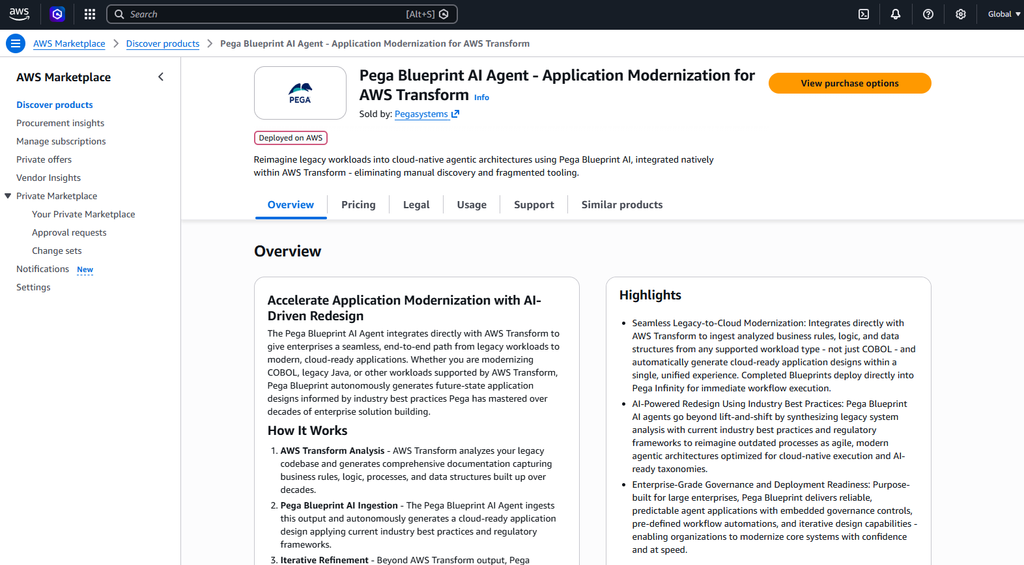
The proposed journey is straightforward in concept. AWS Transform analyses the legacy codebase and extracts and documents business rules, application logic, dependencies, processes, and data structures. Pega Blueprint consumes the resulting analysis and uses that knowledge to generate a future-state application design. Business and technical teams then review and refine the design, and the approved Blueprint can be used to accelerate application creation in Pega Infinity.
The AWS Marketplace description for the Pega Blueprint AI Agent describes this as a direct integration, creating an end-to-end route from legacy analysis to a cloud-ready Pega application design.
This is what makes the collaboration strategically important.
AWS brings powerful cloud infrastructure and specialized legacy-analysis capabilities. Pega brings its workflow platform, case-management strength, industry knowledge, and AI-assisted application-design capabilities. Together, they address both sides of the modernization challenge. AWS Transform analyses the legacy estate, discovers technical dependencies, extracts embedded business logic, documents the existing system, and helps prepare it for cloud transformation. Pega Blueprint designs the future-state application, defines cases, stages, personas, and data, reimagines the business process, produces an application model, and accelerates delivery into Pega Infinity.
This is not simply a code-conversion story.
It is a legacy-understanding plus business-reimagination story.
Why this matters to Pega professionals
What should a Pega professional do with this information?
If you are an LSA or part of a Pega CoE in a large organization, start looking beyond the applications that are already built on Pega. Many enterprises still operate important applications on COBOL and mainframes, Lotus Notes, legacy Java frameworks, older .NET applications, heavily customized workflow technologies, and departmental applications with limited documentation.
These systems may appear outside the traditional Pega boundary.
But they could represent some of the biggest future opportunities for the Pega platform.
The CoE can start identifying legacy applications with high maintenance costs, applications blocking cloud-adoption programmes, systems with significant technical debt, manual processes hidden behind old user interfaces, workloads where business knowledge is trapped in code, and applications that would benefit from case management and workflow automation.
Pega Blueprint can then become a powerful discovery and modernization tool, not merely an application-generation feature.
For organizations already using AWS as their preferred cloud provider, the story becomes even stronger.
AWS Transform can help analyse the current technology estate, while Pega Blueprint and Pega Infinity can provide a path towards modern, cloud-ready workflows.
Application modernization has always been one of the strongest use cases for Pega, and what is changing now is the scale and speed at which Pega can participate in that journey. AWS Transform understands what was built, and Pega Blueprint helps design what should be built next.
For Pega CoE teams, architects, and partners, this opens a much larger opportunity. Do not look only at the existing Pega application estate. Start looking at the legacy estate surrounding it, because that may be where the next major Pega transformation opportunity is waiting.
I am looking forward to seeing many more innovations, and real customer success stories, around the Pega and AWS modernization journey 😊