
Beyond the Hype: What Pega Blueprint Is (and What It Is NOT)

In this blog article, we are going to dive deep into the reality of Pega Blueprint. While the internet is currently flooded with documentation and flashy demos, I want to take a different path. I’m not here to recite the different phases of Blueprint or the official “Blueprint Delivered” methodology there are plenty of excellent articles on the official Pega site if you want to study the basics.
Instead, I want to offer my practical insights and thoughts. I feel I can speak with some authority on this because, during my last assignment, we didn’t just “try” it – we drove the Blueprint delivery methodology to transform a complex legacy application within the airline industry.
Rather than asking “What is Blueprint?”, let’s flip the script. I want to talk about what it is not (or at least, what it is not just). Let’s get started!
1. Blueprint Is Not Just a Developer Productivity Tool
When Blueprint was first introduced, my initial impression was that it was mainly a developer productivity accelerator. At the time, many organizations were riding the GenAI wave, so it was easy to assume Blueprint was simply Pega’s way of joining that conversation or perhaps a strong marketing theme for events like PegaWorld.
But the vision behind Blueprint is much larger than that.
Blueprint is not merely about helping developers move faster. It is fundamentally a collaboration platform that brings business and IT together right from the earliest stages of a project. If you have a decade of Pega experience, you’ll recognize this as the evolution of DCO.
It has also earned the nickname “Legacy Slayer” With capabilities such as Notes-to-Blueprint for modernizing retired Lotus Notes applications, Pega is clearly extending its value beyond greenfield development. In that context, the acquisition of Sweden-based Adopteq was a smart move, especially for organizations dealing with legacy transformation at scale.
2. Blueprint Is Not Just a Sales Demo Gimmick
Enjoying this content?
Access the author’s full video courses here at MyKnowAcademy.
Explore Courses →
A common pattern today is that whenever Pega consulting gets involved, solution conversations often begin with Blueprint. To some, this can make Blueprint look like a polished pre-sales tool as though it is simply a visually impressive way to demonstrate possibilities and create excitement.
Yes, Blueprint can absolutely be used for rapid demonstrations, lead generation, and early stakeholder engagement. It is effective for creating a strong first impression.
But reducing Blueprint to a sales aid alone would be a mistake.
Blueprint should be understood as part of a broader delivery approach. Organizations should invest time in understanding its features, its methodology, and how to use it effectively within enterprise delivery. The end goal should never be just a good demo or a compelling proof of concept. The real goal is to lay the groundwork for a production-ready application.
3. Blueprint Is Not JUST for Hobby Projects
If you follow Pega marketing or the broader developer community, you have probably seen many creative and fun Blueprint-based examples projects like rental apps, sample use cases, and other experimental builds.
These are useful for learning, inspiration, and showcasing what is possible. There is absolutely value in that.
However, it is important not to conclude that Blueprint is only suited for lightweight or hobby-style projects.
Blueprint can be used to model and accelerate serious, enterprise-grade business processes, including complex workflows across industries. In my experience, it can absolutely support real transformation initiatives when used correctly.
So yes – enjoy the fun projects, build them often, and learn from them. But do not underestimate Blueprint by assuming that is all it is good for.
4. Blueprint Is Not Just Another GenAI Product
Blueprint is undeniably powered by GenAI, and that is a major part of its appeal. But it would be overly simplistic to label it as just another GenAI product.
Behind the experience, there is significant engineering and platform depth: industry context, case classification, lifecycle design, data modeling, live previews, iterative refinement, and metadata generation. Blueprint is not simply “AI generating screens.” It is a structured product built on top of substantial platform intelligence.
More importantly, GenAI does not “take over” the design process. In Blueprint, the team remains in control. Architects, analysts, and business stakeholders shape the outcome, while GenAI acts as an accelerator and collaborator.
That distinction matters. Blueprint works best when AI complements human expertise, not when it replaces it.
5. Blueprint Is Not an Alternative to Figma — It’s More Than That
I once heard a business analyst say, after seeing the live preview, “So this is like Figma – I can design my app UX here, right?”
The answer is: not exactly.
Figma is an excellent UX design tool, and it plays a valuable role in many delivery teams. But Figma produces designs that still need to be implemented separately in a development environment.
Blueprint goes beyond visual design.
With Blueprint, you are not just creating mockups, you are defining application structure, case flows, and metadata in a way that can be carried forward into the Pega delivery lifecycle. The resulting Blueprint file can be imported into Pega App Studio, giving the team a significant head start.
That makes Blueprint more than a design tool. It is a bridge between concept and implementation.
It is also worth noting that Blueprint drives you toward a Constellation-based application, which means the resulting UX is aligned with modern standards and established design patterns.
6. Blueprint Does Not Do All the Magic for You
Blueprint gives you a strong starting point: templates, case designs, data models, and an exportable Blueprint file that can be imported into a Pega environment.
That is powerful, but it is still only the beginning.
Blueprint does not eliminate the need for proper delivery, architecture, and implementation. It does not automatically produce a fully production-ready application. Once the Blueprint is created, the real value comes from authoring, refining, and extending it through disciplined implementation.
From a business perspective, Blueprint can significantly reduce development effort often by 50–60%, depending on the complexity of the application. But that does not mean the remaining work disappears.
A real Pega application involves much more than just cases. You still need to consider supporting processes, security, portal design, integration patterns, operational readiness, and delivery planning. Stories must still be written. Decisions still need to be made. Design still needs to be governed.
Blueprint accelerates the journey, but it does not complete it for you.
And most importantly it is not going to replace Pega developers, but only reduce the effort involved!
7. Blueprint Is Not About Completing Everything in Minutes
Technically, yes, you can click through prompts, accept every GenAI suggestion, and complete something in a few minutes.
But that is not how Blueprint should be used in a serious delivery environment.
In a real production scenario, Blueprinting is often a collaborative exercise involving multiple sessions and multiple stakeholders: business teams, architects, LSAs, SSAs, product owners, scrum masters, testers, and others. That was certainly the case in my previous airline engagement.
During case design and data model design especially, experienced roles such as the LSA and LBA play a critical part in shaping a future-proof solution. In practice, this means you will likely reject many of the initial AI-generated suggestions, refine the model repeatedly, and create multiple Blueprint iterations before reaching a final version.
If a Blueprint is completed in a single rushed session, it is often a sign that the exercise was exploratory rather than delivery-focused. Serious enterprise Blueprinting takes time, alignment, and thoughtful iteration.
8. Blueprint Is Not Only for the Start of a Project
Many people think of Blueprint as something used only at project initiation. That is too narrow a view.
Pega also provides the ability to extend an application using Blueprint. Existing applications can be exported into a Blueprint file and then used as supporting input for future enhancement work. This means Blueprint can continue to play a role across multiple MVPs and releases, not just at the beginning.
In other words, the journey can look like this: start with Blueprint, author and deliver in App Studio, release to production, and then return to Blueprint again for the next phase of evolution.
Another important use case is modernization. Existing Pega applications including traditional UI-Kit applications can also be brought into Blueprint as part of a modernization effort.
One practical note from experience: if the application rulebase is very heavy, exporting it into a Blueprint file can be challenging.
9. Blueprint Does Not Train on Your Data
When you use Blueprint, you are interacting with a proprietary Pega application powered by GenAI. Think of it like Pega’s internal tools for Support, PDC, or PDM.
When you provide industry documents or screenshots (and you should always be careful not to include sensitive data with any LLM), the question is: where does it go? Pega is not using public foundation models; they use models deployed in their own secure data centers.

As Pega’s CTO Don Schuerman has noted, your data remains your data. Pega also utilizes regional data centers, ensuring that data for European clients, for example, stays within Europe. example, European client Blueprinting activity remains within European data center boundaries.
10. “No Sprint Without Blueprint” Might Be a Bit Extreme
At PegaWorld ’25, one of the phrases that stood out was: “No sprint without Blueprint.”
It is a memorable line. It sounds great. And it captures the strategic importance Pega is placing on Blueprint.
But in real-world delivery, I believe that statement is still a bit too extreme.
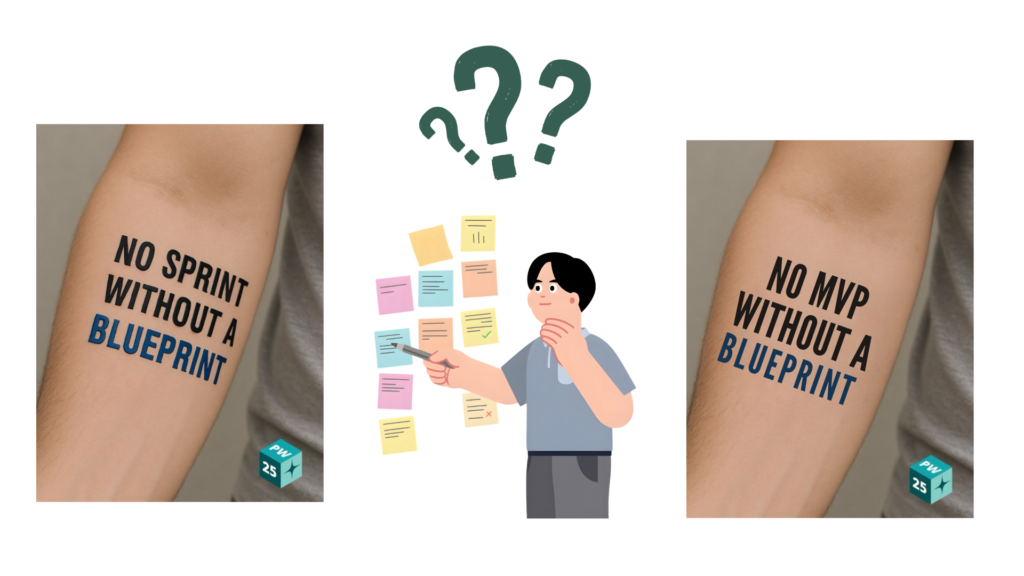
Blueprint can absolutely play an important role across multiple sprints, especially during the early stages of an MVP. But once the project moves deeper into authoring and implementation, there will naturally be sprints where the focus is on delivery execution rather than returning to Blueprint.
A more practical statement, in my view, would be:
“No MVP or release without a Blueprint.”
As of March 5, 2026, that feels like the more realistic and sustainable position. Over time, as the Blueprint-delivered methodology becomes more tightly woven into enterprise delivery, the original slogan may become more practical. But today, most real projects are not there yet.
Final Thoughts
Blueprint is powerful, but its real value becomes clear only when we stop looking at it in narrow terms.
It is not just a developer accelerator.
It is not just a demo tool.
It is not just for hobby projects.
It is not just another GenAI feature.
Blueprint is best understood as a collaborative application design and delivery accelerator, one that can meaningfully improve how enterprises define, modernize, and deliver applications when used with the right mindset.
Used well, it can shorten timelines, improve alignment, and provide a stronger foundation for delivery. But it still requires experience, structure, and disciplined implementation.
That is the key: Blueprint is not magic, but it can be transformational.
