
The One Skill That Can Improve Your Pega Proficiency Faster
There is one skill that can quietly change your entire Pega journey, and in my view, it is this:
Understanding the platform better.
I have seen this graph in myself very clearly.
During my first few years, I was almost zero on the platform-understanding side. I could write activities, configure agents, work with SLA rules, and build what was asked. On paper, I was doing Pega work. But I was still missing something important.
I did not truly understand how Pega was working underneath.
I knew the features, but not the engine behind the features.
I knew how to configure things, but not how the platform was powering them.
That gap matters more than many developers realize.
A simple comparison I still remember
I still remember something my brother told me when I first started learning to drive a car.
Enjoying this content?
Access the author’s full video courses here at MyKnowAcademy.
Explore Courses →
He said, before you start driving, try to understand the car better.
You do not need to become a mechanic. Nobody is asking you to dismantle the engine and rebuild it. But you should at least know how the car is assembled, what the key parts do, what features are available, and how the machine supports the person holding the steering wheel.
Once you know that, stepping into the driver’s seat feels different.
It is not completely new anymore.
There is already a bit of familiarity.
A bit of confidence.
I think the same logic applies to learning any skill, and definitely to learning Pega.
The more you understand the platform, the better your Pega skills become.
So the obvious question becomes:
How do you understand the platform better?
From my experience, here are five things that genuinely helped me.
1. Prefer Pega documentation over only Pega Academy content
If you are a senior Pega developer, there is a good chance you have already spent time in Pega documentation. Earlier, many of us used the help files deployed along with the Pega platform. That was one of my first real learning sources.
During my offshore project days, I used to go through Pega help articles for individual rules. Not just the popular ones. Even the ones that were not commonly used in day-to-day development. For example, there used to be something called Case Match. Many developers today may not even remember it. https://community.pega.com/sites/pdn.pega.com/files/help_v55/rule-/rule-declare-/rule-declare-casematch/main.htm But that kind of exploration helped me understand how broad and deep the platform really is.
What I always felt is this – there is a clear difference between Pega Academy and Pega documentation.
Pega Academy is curated well. It is structured nicely. It is designed for guided learning. That is useful.
But Pega documentation is where the deeper platform understanding often begins.
Documentation usually gives you more technical detail, more implementation-level explanation, and more insight into why something works the way it does. In many Academy topics, you will eventually find documentation references anyway.
So my suggestion is simple:
Do not stop with Academy. Go further. Read the documentation.
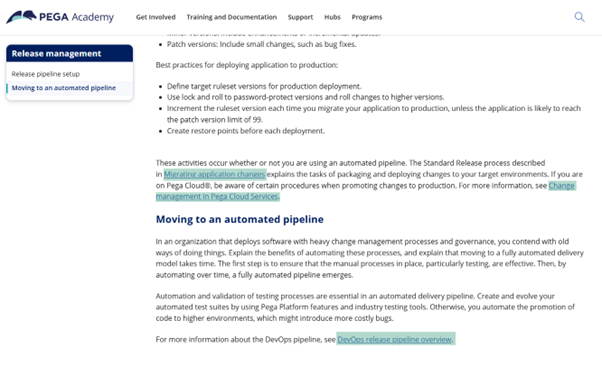
Very often, every line in Pega documentation is trying to tell you something important. If you slow down and understand those details, your platform understanding improves significantly.
2. Trace, trace, trace
Most developers know Tracer as a debugging tool. They use it when something goes wrong.
That is useful, of course. But I learned a lot when I started using Tracer even when nothing was broken.
There is a common belief that learning increases when you make mistakes and investigate them. That is true. As an active developer, you will definitely trace rule executions when you are trying to understand issues.
But I also used to trace things out of curiosity.
I would trace standard case creation.
I would trace how assignments were opened.
I would trace what Pega was doing behind the scenes with utilities, APIs, and out-of-the-box orchestration.
That was one of the biggest shifts in my learning.
Instead of only asking, How do I fix this issue?
I started asking, How does Pega actually do this internally?
That mindset helps a lot.
If you look at many of my technical blog articles, I often try to show what is happening at the backend as well. That is because backend orchestration is where much of the real platform learning happens.
Tracer is not just a troubleshooting tool.
Used properly, it becomes a platform-learning tool.
3. Learn from the challenges faced by other community members
To be honest, I was not a very active contributor in the Pega support forums during my early years. But I still learned a lot from them.
I used to go through support questions raised by other developers and then carefully read the answers from experts. I still remember names like Rajiv Nistala, Shantanu, and a few others whose answers I used to follow closely.
Sometimes I would even open their profiles and read their responses to completely different questions.
At this point you may think, that sounds very nerdy.
Maybe it was. But I genuinely enjoyed it.
Different questions expose you to different problems. Different answers expose you to different ways of thinking. Different experts explain the same topic with different depth and perspective. That kind of exposure helps more than people think.
Now the Pega support experience has evolved and there are more ways to get involved through forums and expert circles. If you are serious about improving your platform understanding, spend time there.
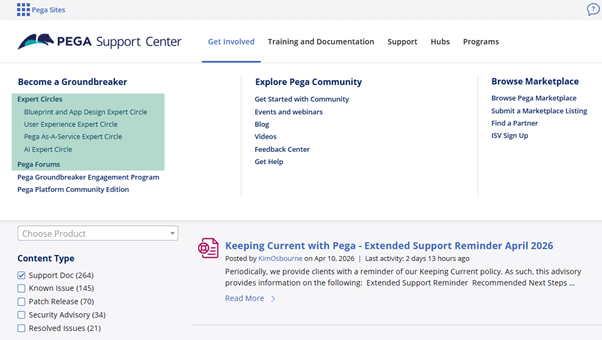
You will find real-world issues.
You will see how experienced people think.
You will come across design trade-offs you may not see in training content.
And today, if you want to get started with newer topics like Pega Blueprint, Constellation, or AI, these community spaces are still among the best places to see what people are really facing in projects.
Even casually reading interesting answered questions can improve your learning curve a lot.
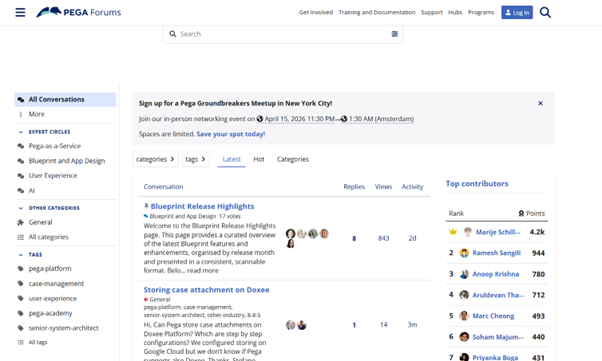
And yes, if you contribute consistently, you also build your visibility and ranking over time.
4. If you get a chance to work on the DevOps side, grab it with both hands
One of the biggest learning phases in my career came during my time at Rabobank between 2017 and 2023.
Those were truly valuable years for me.
Back then, we were working in a more T-shaped model, trying to develop secondary skills alongside core Pega work. That exposure changed my understanding in a big way.
We were on-premise at first, and that is where I learned more about RHEL (Red Hat Enterprise Linux). Later, when we moved to the cloud on Azure, I got exposure to Docker and Kubernetes. I also had the opportunity to work more closely with reliability engineers and learn from them directly.
That kind of work opens your eyes.
You start seeing that enterprise application delivery is not only about case types, activities, and flows. There is an entire surrounding ecosystem that supports the application. Infrastructure, deployment, authentication, storage, monitoring, scaling, configuration management all of that matters.
I worked with YAML files, deployment pipelines, and environment-level concepts that were outside classic Pega development. It was before the ChatGPT era, so learning some of these things took more effort than it would today.
Now GenAI can definitely help simplify the learning curve. It can help you understand YAML, deployment patterns, and technical concepts much faster.
But the real point is this:
Whenever you get an opportunity to work on something slightly outside the core Pega boundary – SSO setup, file storage integration, infrastructure collaboration, deployment configuration, take it.
It can be frustrating.
It can feel uncomfortable.
It can slow you down in the beginning.
But in the long run, it gives you a stronger platform view and makes you a much better engineer.
5. Spend time learning consistently
The final tip is the simplest one, but also the one most people underestimate.
Spend time learning.
The best investment you can make is in yourself.
If you want to understand the platform better, and if you want to understand the supporting technologies around it better, you have to consciously give time to learning. That edge does not come automatically.
It comes from repeated effort.
It comes from reading.
It comes from exploring.
And today, the opportunity is even bigger.
AI is trending heavily, and rightly so. Pick up a few good courses. Learn the basics properly. See how AI can be integrated with Pega. See how it fits into enterprise architecture. Keep an eye on where the platform is going, but also keep strengthening your fundamentals.
Because trends will change. Tools will change. Features will change.
But a developer who truly understands the platform will always have an advantage.
Final thought
A lot of developers focus only on building faster.
But at some point, growth comes from understanding deeper.
That was true in my journey as well.
The moment I started becoming curious about the platform itself, not just the features I was using my confidence, decision-making, and overall Pega proficiency started improving.
You do not need to know everything.
You do not need to become a platform internals expert overnight.
But if you keep making small efforts to understand how Pega works behind the scenes, that one skill can change your proficiency more than you expect.
