


If you have been working in the Pega ecosystem for years, you already know where PCLSA / CLSA stands in the certification ladder. It is generally seen as the highest certification for mastering the Pega platform from a solution architecture perspective. Yes, there is also the LDA path on the decisioning side, but when it comes to core platform credibility, Pega CLSA still carries a special weight.
This article is mainly for people who are asking questions like these:
- I already have 8 to 10 years of Pega experience. Should I still go for CLSA now?
- I am already CSSA certified and playing a lead role in my team. Do I really need CLSA?
- If I am already doing the job, what is the real value of the certification?
That is the real discussion here.
My own reason for doing CLSA
When I did my certification back in 2017, my reasons were quite simple.
I felt I was strong enough in Pega concepts and wanted to challenge myself. At that time, I was also working in an organization where the Pega CoE mainly had certified LSAs, and naturally that made the certification feel more important. On top of that, I had just started writing blogs, so somewhere in my mind, certification also gave a sense of authority and credibility.
So yes, for me, it was not one dramatic reason. It was a mix of ambition, environment, and timing.
But this article is not really about my story. It is about yours.
First, let us be honest: certification is not the same as skill
This is something I strongly believe.
You should never judge a Pega professional purely by certification. Skill and certification are not the same thing.
I have worked with senior Pega developers who had 12 to 14 years of solid experience, no CLSA certification, and yet they were excellent in design thinking, problem solving, and real project delivery. They absolutely had the capability. They just did not have the badge.
I have also seen the reverse. People with the CLSA certification who were not always comfortable when discussions moved into broader enterprise architecture, solution trade-offs, or real-world design pressure.
So let us keep this clear: CLSA does not automatically make someone a great architect. And not having CLSA does not mean someone lacks architectural strength.
You can improve your Pega design and development skills in many ways – through documentation, Pega Academy, webinars, community discussions, project exposure, architecture reviews, and continuous learning. Certification is only one part of that journey.
Still, that does not mean CLSA Certification has no value.
It does have value. In fact, in many cases, it has very practical value.
So why should you still consider CLSA?
Here is my honest take.
1. It gives confidence and visible authority
This is the first real benefit I personally felt.
In organizations where many senior Pega professionals work together, design discussions are often not just about technical correctness. They are also about how confidently you present your ideas, how clearly you defend your design, and how much credibility people naturally assign to your voice.

Having the CLSA badge can give you that extra level of confidence.
It does not magically improve your knowledge overnight. But it does help you step into conversations with more authority, especially when you are moving from a senior developer role into a lead or architect role.
Now, if you are already a strong senior CSSA who is leading teams confidently, this point may not matter much to you. But for many professionals who are technically strong yet still hesitate to fully step into architecture ownership, CLSA can become that push.
Sometimes the value of certification is not just what others think. It is also what it unlocks in your own mindset.
2. It still matters in the job market
This is the practical side that many people do not like to say too openly, but it is true.
A lot of companies, especially service-based organizations, explicitly ask for CLSA-certified professionals. In many job postings, it is not just preferred. It is listed as mandatory.
Why? Because certification influences positioning.

For service companies, certified resources often help in client confidence, commercial structuring, and billing categories. Whether we like that reality or not, it exists. A CLSA-certified profile can often be positioned at a higher rate compared to a non-certified one, even when actual skill levels may vary.
That is why CLSA can directly help in:
- Opening more job opportunities
- Improving your market visibility
- Strengthening your profile for lead and architect roles
- Supporting better compensation conversations
3. Infinity ’25 may actually be a good time to do it
This point is especially relevant now.
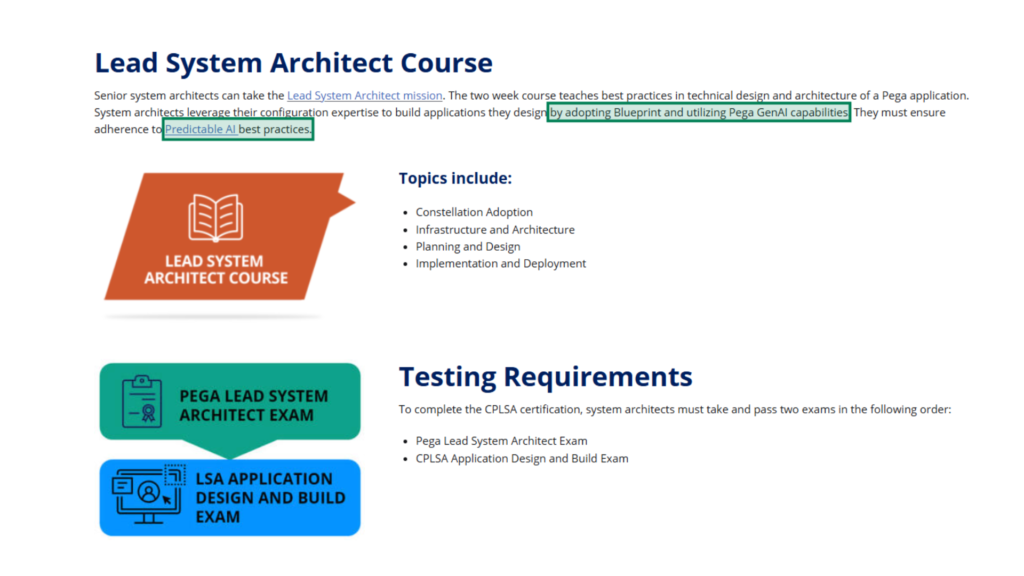
The Pega platform is clearly shifting. GenAI, Blueprint, and faster application delivery models are becoming more central to how solutions are designed and discussed.
That makes this an interesting moment.
If you have been postponing CLSA for years, Infinity ’25 may be the right time to seriously consider it. Not because older versions were not valuable, but because the certification now sits in a more visible transition phase of the platform itself.
And from a profile perspective, being certified in the newer era of Pega can create an additional edge. It signals that you are not just experienced in traditional implementation, but that you are also aligned with where the platform is going next.
4. It helps you grow beyond normal development work
This is one of the most underrated reasons.
Many Pega professionals spend years becoming very efficient at core implementation work like activities, data transforms, flows, integrations, case design, troubleshooting, guardrails, and delivery. That is all valuable. But at some point, career growth needs a wider shape.
The CLSA journey can help you grow from someone who builds into someone who designs, guides, reviews, and influences.

That shift matters.
Because once you are seen as an architect, your contribution goes beyond development. You become more relevant in areas like:
- Solution shaping
- Pre-sales discussions
- Architecture review boards
- Mentoring junior team members
- Evaluating senior candidates
- Setting delivery standards
- Guiding modernization decisions
This is where CLSA can have a multiplier effect. It is not just about passing an exam. It is about strengthening your position in the broader ecosystem around delivery.
So, do you need CLSA if you already have experience?
My honest answer is this:
No, CLSA is not mandatory to be a capable Pega architect.
But yes, CLSA can still be a very smart career move, even if you already have years of experience.
If you already have strong hands-on exposure, then CLSA is not redundant. It becomes a way to formalize your position, sharpen your profile, and step more confidently into architecture-led responsibilities.
It is less about proving that you can create a case or configure a rule.
It is more about this:
Can you position yourself as the person who can shape the solution, defend the design, guide the team, and represent architecture with confidence?
That is where CLSA becomes meaningful.
Final thought
If you already have solid Pega experience, CLSA is not just another certification to collect. It is a career positioning decision.
It gives you stronger market visibility, more authority in architecture conversations, and a more formal identity as someone who can lead solution design not just contribute to implementation.
So no, I would not say everyone must blindly chase CLSA.
But if you are already experienced, already carrying lead responsibilities, or already thinking like an architect, then going for CLSA may not be an unnecessary step.
It may actually be the most natural next step.